
I know this isn’t the most exciting topic – especially if you just got a pool and all you want to do is figure out how to keep the water clear. But pool safety is one of those things you really don’t want to learn the hard way. Drowning is the leading cause of accidental death in children ages 1 to 4, and the vast majority of those incidents happen in residential pools. It happens fast – usually within a minute or two, and usually quietly.
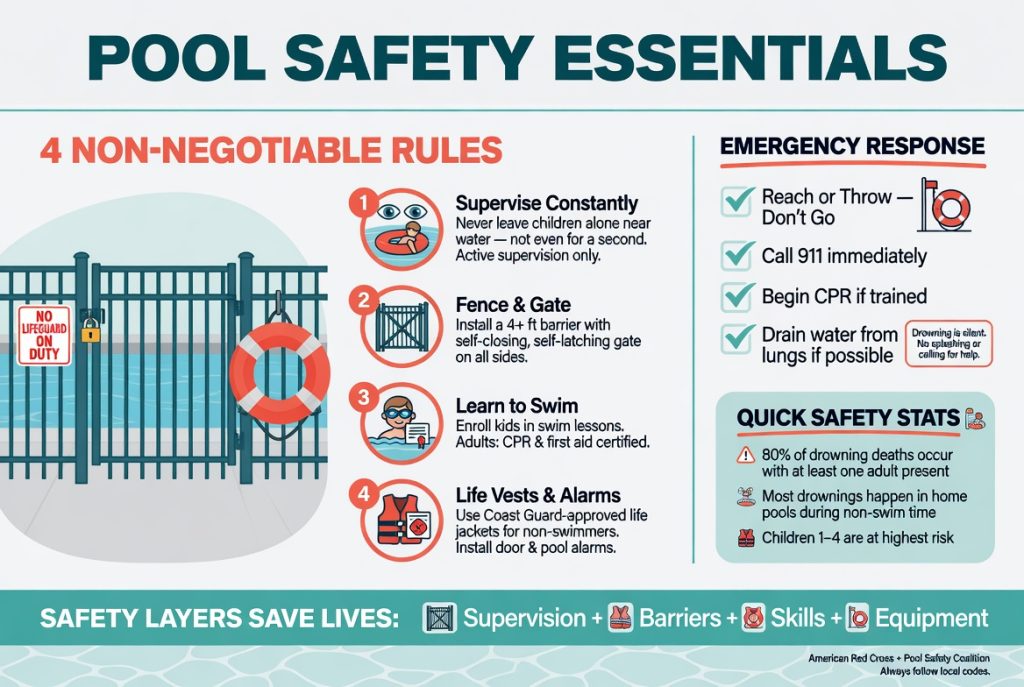
So here’s a quick rundown of the things that actually make a difference. Not a lecture, just the basics.
Start With the Fence
If you have young kids – or grandkids, or neighbors’ kids who come over – a four-sided fence specifically around the pool is the most effective thing you can do. Not a fence around the yard. A fence that separates the pool from the house, so a toddler who slips out the back door can’t just walk right up to the water.
The standard is at least 4 feet tall with a self-closing, self-latching gate. The latch should be at the top, out of a small child’s reach, and the gate should swing away from the pool. This sounds obvious but a lot of fences get installed wrong on that last point.
Check your local ordinances – most cities have specific requirements and many require a permit if you don’t have compliant fencing already. The Pool Safely campaign run by the U.S. Consumer Product Safety Commission has a solid breakdown by state, and it’s where I’d send anyone who wants to understand why each rule exists.
Pool Alarms
A fence is your primary line of defense. Alarms are the backup for when the gate gets propped open at a party or a determined 4-year-old figures out the latch. A few types worth knowing:
- Door and gate alarms – beep when any entry point to the pool area opens. Cheap, simple, easy to install, worth having on every door that has pool access.
- Surface wave sensors – these float in the pool and trigger an alarm when something falls in. They can false-alarm in heavy wind, but for calm conditions they work pretty well.
- Wearable wristband alarms – the child wears a band that goes off when submerged. Good for an extra layer if you have toddlers who are quick.
- Subsurface motion sensors – mounted underwater and detect movement below the surface. Less sensitive to wind than floating surface detectors.
No alarm replaces supervision. But alarms close the gap during the few minutes your attention is genuinely somewhere else.
The Virginia Graeme Baker Act – Worth Knowing About
A lot of pool owners have never heard of this one. The Virginia Graeme Baker Act was passed in 2007 after a 7-year-old girl drowned when the suction from a hot tub drain trapped her underwater. The law requires anti-entrapment drain covers on all pools and spas to prevent this from happening.
If your pool was built before 2008, check your drain covers. Flat covers are a red flag – compliant ones are dome-shaped with sufficient open area to limit suction force. They’re cheap to replace and worth doing even if your pool passes a general inspection. Suction entrapment is rare but it’s a real hazard that doesn’t get talked about enough.
Set the Rules and Actually Enforce Them
Every household with a pool should have a short list of non-negotiable rules. Ours are pretty standard:
- No one swims alone – period
- Kids under a certain age don’t get in without an adult in the water with them, not just sitting nearby on a phone
- No running on the deck
- No diving unless you know the exact depth and there’s a proper area for it
- Everyone in the household knows where the pump shutoff is, in case something gets stuck against a drain
The temptation is to relax these once everyone gets comfortable with the pool. That’s exactly when you shouldn’t.
Learn CPR
Seriously – if you have a pool, learn CPR. It takes a few hours, it’s offered everywhere, and it’s the thing that keeps someone alive in the minutes before an ambulance arrives. The American Red Cross offers in-person and online options. This goes in the same category as having a fire extinguisher in your kitchen. Basic responsible ownership.
The CDC’s drowning prevention page has good statistics and guidance. And poolsafety.gov is worth bookmarking and sharing with anyone who spends regular time at your pool.