
Quick Answer
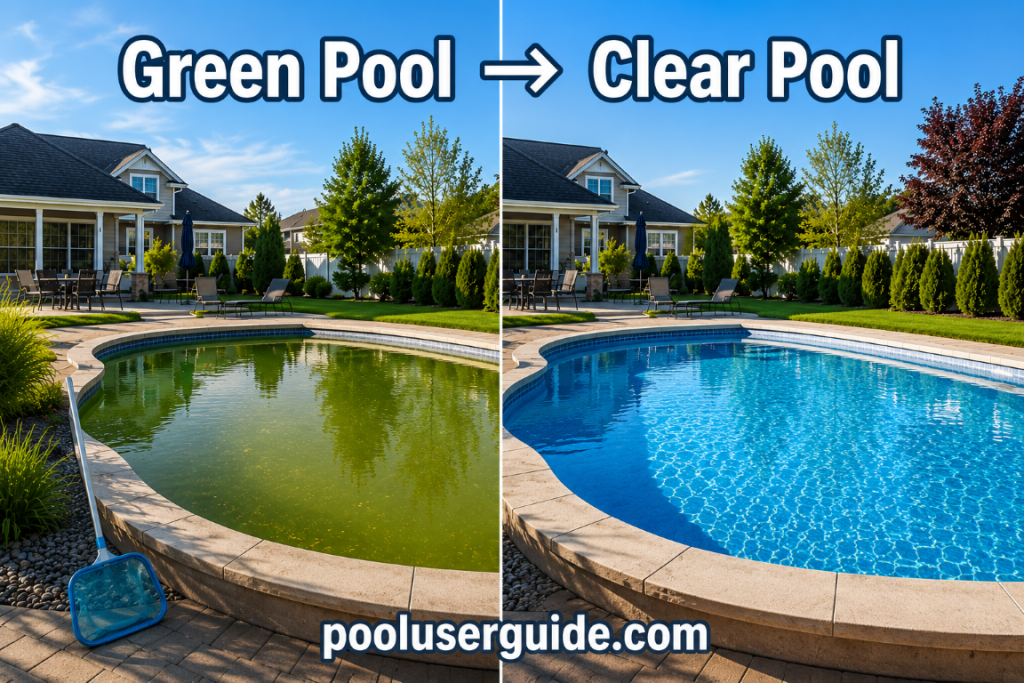
A green pool means algae has taken over, and the only reliable fix is the SLAM method (Shock, Level, And Maintain): bring chlorine to shock level and hold it there until the algae is dead. This is not a “dump some shock and hope” situation — it’s a deliberate process that takes 2–7 days depending on severity. The total cost is typically $30–75 in chemicals for a DIY fix. Don’t waste money on algaecides or “quick fixes” — chlorine is the only thing that kills algae.
What You Need to Know
- Green = algae = low chlorine. Period. Algae can only grow when free chlorine has been inadequate for your CYA level. Fix the chlorine, kill the algae.
- Algaecides are preventive, not curative. Once you have a full bloom, algaecide alone won’t clear it. Only chlorine at shock level works.
- Don’t drain the pool. Even a swamp is recoverable. Draining risks structural damage, and you’ll spend more on fresh water and chemicals than on clearing the existing water.
- The SLAM method works every time if followed correctly. It’s the gold standard recommended by pool professionals and the TFP (Trouble Free Pool) community.
- Speed depends on severity: Light green (can see bottom) = 1–2 days. Dark green (can’t see bottom) = 3–5 days. Black/swamp = 5–7+ days.
Deep Dive
Understanding Pool Algae
Types of Pool Algae
| Type | Appearance | Location | Difficulty |
|---|---|---|---|
| Green algae | Green water, green slime on walls/floor | Everywhere — free-floating and on surfaces | ⭐ Easy — responds well to chlorine |
| Yellow/mustard algae | Yellowish-brown powder on shady walls | Shaded walls, corners, steps | ⭐⭐ Moderate — chlorine-resistant, brushes off but returns |
| Black algae | Dark blue-black spots with roots | Rough surfaces — plaster, grout, concrete | ⭐⭐⭐ Hard — has a protective outer layer and roots into surfaces |
| Pink slime | Pink/reddish film, slimy | Skimmer, light niches, PVC fittings | ⭐⭐ Moderate — actually a bacteria, not true algae |
This guide focuses primarily on green algae (the most common by far). Yellow, black, and pink require modified approaches covered below.
Why Did Your Pool Turn Green?
Algae needs three things: water, sunlight, and nutrients. You can’t remove any of those from a pool. The only thing preventing algae is adequate chlorine. Your pool turned green because:
- FC dropped below the minimum for your CYA level — even for a day or two in summer
- Pump wasn’t running — power outage, timer issue, or equipment failure
- CYA is too high — requiring unrealistically high FC levels to be effective (CYA over 80–100 makes this very difficult)
- CYA is too low (or zero) — UV destroyed all your chlorine during the day
- Heavy rain/contamination — diluted or consumed your chlorine faster than you could replenish it
- Tablet chlorinator ran empty and nobody noticed
The SLAM Method: Step by Step
SLAM stands for Shock, Level, And Maintain. It’s not just dumping shock once — it’s raising chlorine to a specific level based on your CYA and maintaining it there until three criteria are met.
Before You Start: Gather Supplies
| Item | Why You Need It | Approx. Cost |
|---|---|---|
| Liquid chlorine (10–12.5%) | Your primary weapon. Buy more than you think you need (2–4 gallons for mild green, 6–10 gallons for dark green/swamp) | $4–6/gallon |
| FAS-DPD test kit | Must be able to measure FC at high levels (above 10 ppm). Test strips can’t do this. Taylor K-2006 is the gold standard. | $50–80 (one-time) |
| Muriatic acid | Liquid chlorine raises pH — you’ll need acid to keep pH below 7.8 | $8–12/gallon |
| Pool brush | Brushing exposes algae to chlorine. A stiff nylon brush for most surfaces; stainless steel brush for plaster with black algae. | Already have |
Step 1: Test CYA and Determine Your Shock Level
CYA (cyanuric acid/stabilizer) determines how much chlorine you need. Higher CYA requires higher FC to kill algae. This is the critical relationship:
| CYA Level (ppm) | SLAM FC Target (ppm) | Normal FC Minimum (ppm) |
|---|---|---|
| 0 | 10 | 2 |
| 20 | 12 | 3 |
| 30 | 12 | 4 |
| 40 | 16 | 5 |
| 50 | 20 | 6 |
| 60 | 24 | 7 |
| 70 | 28 | 8 |
| 80+ | 31+ | 9+ |
Step 2: Bring FC to SLAM Level
- Test your current FC and CYA.
- Calculate how much liquid chlorine you need to reach your SLAM FC target. As a rough guide for a 15,000-gallon pool: each gallon of 10% liquid chlorine raises FC by about 8–9 ppm.
- Add the liquid chlorine with the pump running, pouring it around the pool perimeter (not all in one spot).
- Lower pH to 7.2 with muriatic acid if it’s above 7.4. At shock-level FC, chlorine’s effectiveness is significantly reduced at high pH.
- Wait 30 minutes, then retest FC to confirm you’ve reached your target.
Step 3: Maintain SLAM Level
This is where most people fail. They shock once and walk away. That doesn’t work because:
- Algae consumes chlorine as it dies. A severe bloom can eat 5–15 ppm of FC per day.
- UV from sunlight destroys FC (even with CYA).
- You need to test FC multiple times per day (morning, afternoon, evening) and add chlorine every time it drops below your SLAM target.
Daily routine during SLAM:
| Time | Action |
|---|---|
| Morning | Test FC and pH. Add chlorine if below SLAM level. Add acid if pH above 7.8. Brush the entire pool. |
| Afternoon | Test FC. Add chlorine if below SLAM level. (UV burns off the most FC midday.) |
| Evening | Test FC. Add chlorine to bring FC back to SLAM level before bed. The biggest dose of the day — replenishes for overnight. |
| As needed | Backwash or clean filter when pressure rises 8–10 PSI above clean baseline. This may be needed daily in the first few days. |
Step 4: Know When SLAM Is Complete
SLAM is done when ALL THREE of these criteria are met simultaneously:
- FC holds overnight: The drop from evening to morning is 1 ppm or less (the “overnight chlorine loss test” or OCLT). This means there’s nothing left consuming chlorine.
- CC is 0.5 ppm or less: Combined chlorine (chloramines) is minimal, meaning all organic matter has been oxidized.
- Water is clear: You can see the main drain clearly from the pool deck. The water may still be slightly blue-tinted but not hazy or cloudy.
If any one of these isn’t met, keep SLAM-ing. The overnight chlorine loss test is the most important — it tells you definitively whether all the algae is dead.
Timeline: What to Expect
| Severity | Description | SLAM Duration | Chemical Cost |
|---|---|---|---|
| Light green | Can see bottom, greenish tint, slimy spots on walls | 1–2 days | $15–30 |
| Medium green | Can’t see bottom of deep end, definite green color | 3–4 days | $30–50 |
| Dark green | Can’t see more than 1–2 feet down, thick green | 4–6 days | $50–75 |
| Black/swamp | Can’t see more than a few inches, dark green/black, strong odor | 5–7+ days | $75–150 |
Special Cases: Yellow, Black, and Pink Algae
Yellow (Mustard) Algae
Yellow algae is chlorine-resistant and notorious for returning. It looks like sand or pollen, usually on shaded walls.
- SLAM at 2× the normal SLAM FC level for your CYA.
- Brush aggressively — mustard algae has a protective outer layer that must be disrupted.
- Decontaminate everything: Soak all pool toys, floats, brushes, swimsuits, and goggles in chlorinated water. Mustard algae clings to anything that goes in the pool.
- Run the cleaner to stir up biofilm on the bottom.
- Consider adding sodium bromide (Yellow Out, Yellow Treat) — this converts to hypobromous acid when shocked, which is more effective against mustard algae. Follow the product directions carefully.
Black Algae
Black algae is the toughest to eliminate because it roots into porous surfaces (plaster, grout) and has a waxy protective layer.
- SLAM at your CYA-based level, but this alone won’t kill black algae.
- Wire-brush every spot aggressively with a stainless steel brush (plaster pools only — NOT for vinyl or fiberglass). You must break through the protective cap.
- Apply trichlor tablets directly to each spot — hold a tablet against the wall on each black algae head for 30 seconds. The concentrated chlorine penetrates the root. (Wear gloves.)
- Repeat daily — brush, apply tablet, maintain shock. Black algae takes days to weeks of persistent treatment.
- After clearing: Keep FC at the higher end of the range for several weeks. Black algae often returns if you let your guard down.
Pink Slime (Biofilm)
Pink slime is actually a bacteria (Methylobacterium), not algae. It forms a slimy pink film in low-flow areas.
- SLAM at your normal CYA-based level.
- Physically remove visible pink slime by wiping/brushing.
- Clean inside the skimmer, light niches, return fittings, and ladder hardware — pink slime loves these protected areas.
- Add polyquat 60 algaecide after SLAM as a preventive — it helps prevent biofilm reformation.
After SLAM: Preventing a Repeat
Once your SLAM is complete and the water is clear:
- Let FC naturally drop from SLAM level down to your normal target for your CYA. (Don’t swim until FC is below 4 ppm and water is clear.)
- Add polyquat 60 algaecide as a preventive maintenance dose.
- Address the root cause — why did the algae grow in the first place?
| If the cause was… | Fix going forward |
|---|---|
| CYA too high (requiring unreasonably high FC) | Partial drain and refill to lower CYA. Switch from tablets to liquid chlorine. |
| CYA too low (FC burned off by UV) | Add stabilizer to reach 30–50 ppm (chlorine pools) or 60–80 ppm (salt pools). |
| Not testing/dosing frequently enough | Commit to weekly testing and maintenance. |
| Chlorinator ran empty | Set a reminder to check and fill it weekly. Consider a salt system for hands-off chlorine production. |
| Pump not running enough | Increase runtime to at least 8 hours/day (more in summer heat). Ensure the timer is reliable. |
| Came back from vacation | See our vacation pool care guide for pre-trip preparation. |
Common Mistakes When Clearing Green Pools
| Mistake | Why It Fails | Do This Instead |
|---|---|---|
| Dumping one bag of shock and walking away | FC drops below kill level within hours as algae consumes it. Remaining algae regrows. | SLAM method: maintain FC at shock level continuously until all 3 completion criteria are met. |
| Relying on algaecide alone | Algaecides are preventive, not curative at scale. They can’t kill a bloom. | Chlorine does the killing. Add algaecide after SLAM as prevention. |
| Not brushing | Algae embedded in surfaces is protected from chlorine. Biofilm shields it. | Brush the entire pool daily during SLAM. Focus on walls, steps, and corners. |
| Draining and refilling | Structural damage risk, expensive water bill, and you still have to treat the new water. | Even swamp water is recoverable. SLAM always works given time. |
| Using dichlor/trichlor to shock | Adds massive CYA, which makes you need even MORE chlorine — vicious cycle. | Use liquid chlorine (bleach) only for SLAM. It adds zero CYA. |
| Stopping SLAM too early | Water looks clear but the overnight chlorine loss test still fails — living algae remains. | Don’t stop until you pass OCLT (≤1 ppm loss overnight), CC ≤0.5, and water is clear. |
| Ignoring pH during SLAM | High pH makes chlorine much less effective. At pH 8.0, chlorine is ~25% as effective as at 7.2. | Keep pH at 7.2–7.4 during SLAM. Add acid as needed. |
• DIY SLAM: $30–150 in chemicals + 2–7 days of your time (testing/dosing 3×/day)
• Pool service “green-to-clean”: $200–500+ depending on severity and your area
• The math: DIY is always cheaper, but pool services may be worth it for severe cases or if you don’t have the time/schedule for 3×/day testing
Frequently Asked Questions
Can I use the pool once it’s clear but still in SLAM?
No. During SLAM, FC is far above safe swimming levels (often 15–30 ppm). Wait until SLAM is complete and FC has naturally dropped below 4 ppm. This usually takes 1–3 days after SLAM ends, depending on UV exposure and CYA level.
My pool turned green overnight. How is that possible?
It didn’t actually happen overnight — it was building for days. Green algae in the early stages is nearly invisible. By the time you see a green tint, the bloom is already well-established and grew rapidly once it hit a critical mass. This is why regular testing is so important — catching it at the cloudy/hazy stage is much easier to fix.
I shocked the pool and it turned brown instead of clear. Is that normal?
Yes — that’s dead algae. The green color goes away as the algae dies, and the dead matter turns brown/grey before being filtered out. This is progress. Keep the filter running 24/7 and clean it when pressure rises. The water will go from brown → cloudy → hazy → clear over 1–3 days.
How much liquid chlorine do I need?
Rough estimates for a 15,000-gallon pool:
- Light green: 2–3 gallons of 10% liquid chlorine for the initial dose, plus 1–2 gallons/day to maintain
- Medium green: 3–4 gallons initial, plus 2–3 gallons/day
- Dark green/swamp: 4–6 gallons initial, plus 2–4 gallons/day
Actual amounts depend on your CYA level and how fast the algae consumes chlorine. Buy more than you think you’ll need — returning unopened bottles is better than running out mid-SLAM.
Can I just drain half the water and refill?
A partial drain (30–40%) can help in specific situations: (1) CYA is too high (above 80–90 ppm), making SLAM impractical, or (2) total dissolved solids are extremely high. But for a normal green pool with reasonable CYA, draining isn’t necessary and adds cost and structural risk. SLAM the existing water — it works.
Will my filter handle all the dead algae?
Your filter will clog rapidly during SLAM — that’s expected and normal. For sand or DE filters, backwash whenever pressure rises 8–10 PSI above your clean baseline (you may backwash daily or even twice a day initially). For cartridge filters, you’ll need to remove and hose them off frequently — this is the hardest part with cartridge filters during a major SLAM. Some people keep a spare cartridge to swap in.
Should I vacuum the dead algae or let the filter handle it?
For mild to moderate cases, the filter will handle it. For severe cases with heavy sediment on the bottom, vacuum to waste (bypassing the filter) to remove the bulk of dead algae, then let the filter polish the remaining cloudiness. You’ll lose water and need to refill, but it dramatically speeds up the clearing process.
Related Pages
- Cloudy Pool Water — Catching the problem at the early, easier-to-fix stage
- Pool Shock Treatment Guide — Detailed shocking procedures and dosing
- Chlorine and Sanitizers — Understanding FC, CYA, and their relationship
- Cyanuric Acid (CYA/Stabilizer) — Why CYA level controls everything about algae prevention
- Pool Water Testing — Accurate testing is essential for SLAM success
- Vacation Pool Care — Preventing green pools while you’re away