
Quick Answer
Your pool pump is the heart of the system – it circulates water through the filter, heater, chlorinator, salt cell, and back to the pool. A variable speed (VS) pump is the best choice for almost every pool: it saves 60–80% on energy costs compared to single-speed pumps, runs quieter, and most states now mandate them for new installations. Set it to run 8-12 hours/day at the lowest speed that keeps your water clear. A VS pump for a residential pool costs $800–$1,500 installed and typically pays for itself in electricity savings within 1-2 years.
What You Need To Know
Types of Pool Pumps
| Type | How It Works | Energy Use | Cost | Verdict |
|---|---|---|---|---|
| Single Speed | Runs at one fixed speed (usually 3450 RPM) | High (~2000 watts) | $300–$600 | Outdated. Being phased out by regulation. |
| Dual Speed | Two settings: high and low | Moderate | $400–$700 | Better than single, but limited flexibility. |
| Variable Speed (VS) | Adjustable from ~600 to 3450 RPM | Low (~200-500 watts at typical speeds) | $800–$1,500 | The clear winner. Buy this. |
Why Variable Speed Pumps Save So Much Energy
This is where physics makes pool ownership cheaper. Pump energy consumption follows the Affinity Law – power scales with the cube of speed:
| Speed | RPM | Approximate Power | Daily Cost (12 hrs @ $0.12/kWh) |
|---|---|---|---|
| Full speed | 3450 | ~2000W | $2.88 |
| 75% | 2600 | ~850W | $1.22 |
| 50% | 1725 | ~250W | $0.36 |
| 35% | 1200 | ~85W | $0.12 |
Running at half speed uses about 1/8th the energy. Running at 1200 RPM for 12 hours gives you the same water turnover as 3450 RPM for about 4 hours – but at a fraction of the electricity cost. The water also gets filtered more thoroughly because it passes through the filter slowly at lower flow rates.
💲 Cost: A single-speed pump running 8 hours/day costs roughly $80-120/month in electricity. A VS pump running 10-12 hours/day at optimized speeds costs $20-40/month. That’s $500-1,000+ saved per year – the VS pump pays for itself in 1-2 years, then it’s pure savings for the next 8-10 years of its life.
How to Size a Pool Pump
Pumps are rated in horsepower (HP) and flow rate (GPM – gallons per minute). The right size depends on your pool volume and plumbing:
Pool volume and turnover:
- Your pump should turn over the entire pool volume at least once per day, ideally 1.5-2x per day during summer
- For a 15,000-gallon pool: you need at least 15,000 gallons ÷ 480 minutes (8 hours) = ~31 GPM flow rate
- Most residential VS pumps (1.5-2.7 HP) deliver 30-60 GPM at medium speeds – more than enough
General sizing guide:
| Pool Volume | Recommended VS Pump HP |
|---|---|
| Up to 15,000 gallons | 1.5 HP |
| 15,000–25,000 gallons | 1.5–2.0 HP |
| 25,000–40,000 gallons | 2.0–3.0 HP |
| 40,000+ gallons | 3.0+ HP |
Bigger isn’t always better. An oversized pump running at minimum speed still uses more energy than a properly-sized pump at medium speed, and it can damage equipment by creating too much flow at high speeds.
Setting Up Your Pump Schedule
The ideal schedule uses different speeds for different purposes throughout the day:
| Time Block | Speed | Purpose |
|---|---|---|
| Early morning (6-8 AM) | High (2400-3000 RPM) | Clear overnight debris, strong skim |
| Daytime (8 AM – 6 PM) | Low (1000-1500 RPM) | Quiet filtration, energy savings |
| Evening / swim time (6-10 PM) | Medium (1500-2000 RPM) | Active circulation during use |
| Night (10 PM – 6 AM) | Off or ultra-low (600 RPM) | Minimal cost |
Pro Tip: Start with lower speeds and increase only if water clarity suffers. Many pool owners are surprised to find that 1200 RPM for 12 hours keeps the pool perfectly clear. There’s no need to run at 3000 RPM “just in case.” If the water is clear, the pump speed is adequate.
Deep Dive
How a Pool Pump Works
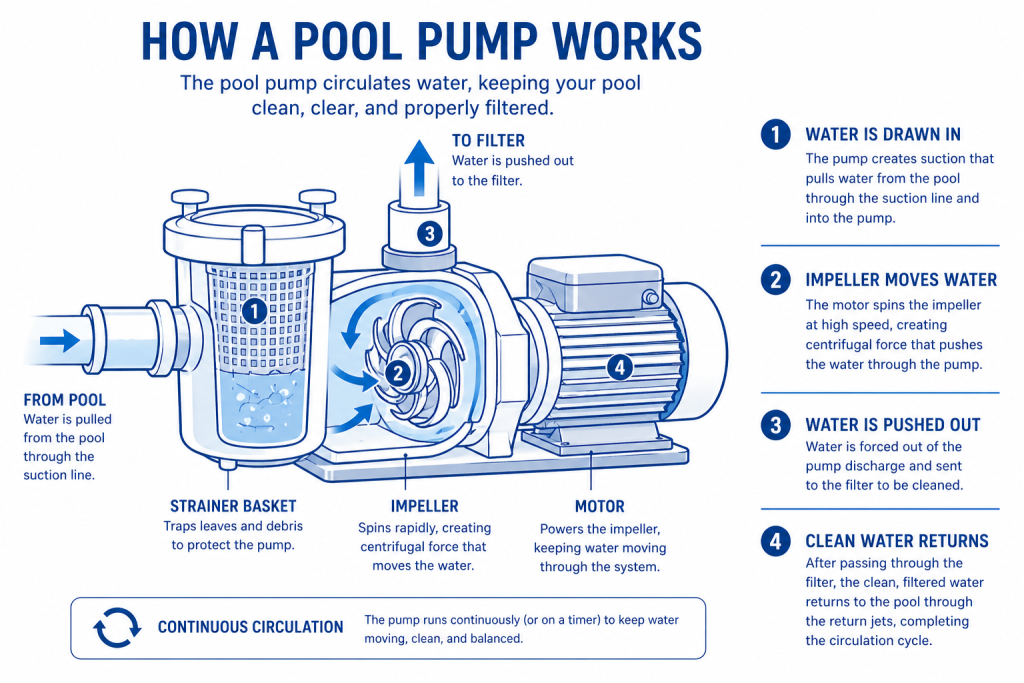
A pool pump is essentially a centrifugal water impeller in a housing:
- Water enters through the suction side (from the skimmer and main drain)
- It passes through the strainer basket (catches large debris like leaves)
- The impeller — a spinning disc with curved vanes — accelerates the water outward
- The volute (the spiral housing around the impeller) converts that velocity into pressure
- Pressurized water exits to the filter, heater, salt cell, and back to the pool via return jets
The motor drives the impeller. In single-speed pumps, it’s a basic induction motor that runs at full speed or not at all. In VS pumps, it’s a permanent magnet motor (like an electric car motor) that can run at any speed the controller requests — quieter, more efficient, and longer-lasting.
Pump Maintenance
Pool pumps are low-maintenance but not zero-maintenance:
Weekly:
- Clean the strainer basket: Turn off the pump. Release the strainer lid (twist or unclamp). Remove the basket, dump debris, rinse, reinstall. This takes 2 minutes and prevents flow restriction. A full basket makes the pump work harder and can cause it to lose prime.
- Check for air bubbles: Look at the strainer housing while the pump runs – it should be full of water with no visible air. Air bubbles in the returns mean there’s a suction-side air leak.
Monthly:
- Inspect the lid O-ring: The O-ring on the strainer lid is the most common source of air leaks. It should be smooth, pliable, and seated flat in its groove. Apply a thin coat of silicone-based O-ring lube (NOT petroleum jelly) every month. Replace if cracked, flat, or stretched.
- Check for unusual noise: A healthy pump hums. Grinding = bad bearings (motor replacement needed). Screaming/high pitch = cavitation (something is restricting suction — check for closed valves, clogged baskets, or low water level).
Annually:
- Check motor ventilation: The motor has air vents for cooling. Clear any dirt, cobwebs, or debris. Spiders love nesting in pump motors.
- Inspect electrical connections: Look for corrosion on the wiring terminals. Pool environments are harsh — moisture and chemicals accelerate corrosion.
Pump Troubleshooting
| Problem | Likely Cause | Fix |
|---|---|---|
| Pump won’t prime (basket stays empty) | Air leak, low water level, clogged impeller | Check lid O-ring; verify pool water above skimmer; clean impeller |
| Air bubbles in return jets | Suction-side air leak | Check lid O-ring, pump drain plugs, all suction pipes/valves |
| Pump is extremely loud | Bad bearings or cavitation | Bearings → motor/pump replacement; cavitation → open all suction valves, check for blockages |
| Pump trips the breaker | Bad capacitor, moisture in motor, wiring issue | Check for water damage in motor; call electrician if repeated |
| Low flow / weak returns | Dirty filter, clogged impeller, pump speed too low | Clean filter; clear impeller; increase pump speed |
| Pump cycles on/off every few minutes | Thermal overload (overheating) | Clear motor vents; ensure shade/airflow; check voltage |
| VS pump shows error code | Varies by model — usually flow or electrical issue | Check manual for specific code; power cycle the pump; check filter pressure |
Pump Priming — Step by Step
If your pump loses prime (strainer basket not full of water, air in lines), follow this procedure:
- Turn off the pump
- Check pool water level – must be above the bottom of the skimmer opening. If low, add water with a garden hose first
- Open the strainer lid – twist counterclockwise or release the clamp
- Remove and clean the strainer basket
- Fill the strainer housing with water using a garden hose — fill it to the brim
- Check the lid O-ring – lubricate with silicone lube, replace if damaged
- Reinstall the basket and lid – hand-tight, don’t over-torque
- Open the air relief valve on the filter (if your filter has one — most cartridge and DE filters do)
- Turn on pump at low speed (if VS) – low speed is gentler for priming
- Watch the strainer: Within 1-3 minutes, water should fill the basket and air bubbles should stop
- Once primed: Close the filter air relief valve when a steady stream of water appears, then increase to normal speed
If the pump won’t prime after 2-3 attempts, there’s likely a significant air leak on the suction side that needs to be found and fixed.
Popular VS Pump Brands
| Brand/Model | HP Range | Price Range | Notes |
|---|---|---|---|
| Hayward Super Pump VS | 1.65 HP | $700–$900 | Popular upgrade for single-speed Super Pump replacements |
| Hayward MaxFlo VS | 1.5–2.7 HP | $800–$1,200 | Works with OmniLogic automation systems |
| Pentair IntelliFlo VSF | 3.0 HP | $1,200–$1,500 | Premium. Variable speed + variable flow. Works with IntelliCenter |
| Pentair SuperFlo VS | 1.5 HP | $700–$900 | Good budget VS option from Pentair |
| Jandy FloPro VS | 1.0–2.7 HP | $900–$1,300 | Integrates with Jandy iAqualink automation |
Pro Tip: If you have a pool automation system (Hayward OmniLogic, Pentair IntelliCenter, Jandy iAqualink), buy a pump that’s compatible with your system. Integrated communication lets the automation set pump speeds automatically based on schedules, features (spa, cleaner, water features), and diagnostics. Mixing brands usually works for on/off control but loses the smart speed integration.
FAQ
How many hours a day should I run my pump?
Enough to turn over the pool volume at least once. For most residential pools with VS pumps at medium-low speed, that’s 8-12 hours. In summer (high heat, heavy use), lean toward 12 hours. In winter (no swimming, cool water), 6-8 hours may be enough. If the water is clear, your run time is adequate.
Can I run my pump 24/7?
Yes, and some pool owners do — especially at very low speed (600-800 RPM). A VS pump at 600 RPM uses about the same energy as a 60-watt light bulb. The benefit is constant circulation and filtration. The downside is slightly more wear on the motor, though VS motors are rated for continuous duty.
My pump is 15 years old. Should I replace it?
Probably, for two reasons: (1) Older single-speed pumps cost 3-5x more in electricity than a modern VS pump. (2) Pumps over 10 years old are increasingly likely to fail – bearings, seals, and the motor all degrade. Proactive replacement lets you choose timing and product; waiting for failure means emergency pricing and whatever’s in stock.
What does “pump HP” actually mean for my pool?
Horsepower ratings can be confusing because manufacturers list different types: “total HP,” “service factor HP,” and “up-rated HP.” What matters is the motor’s actual wattage draw at the speed you’ll use. A 2.7 HP pump running at 1200 RPM may only pull 100 watts – the 2.7 HP rating is its maximum capacity, not its normal operating point. Don’t obsess over HP; focus on whether the pump provides adequate flow at a speed that keeps your water clear.
Is it worth upgrading from a single-speed to variable speed?
Almost always yes. If your single-speed pump costs $80+/month in electricity, a VS pump at $800-1,000 pays for itself in under 2 years. After that, you’re saving $600-1,000/year for the remaining 8+ years of the pump’s life. Many utility companies also offer rebates for VS pump installations ($100-200 in some areas). It’s one of the best ROI improvements you can make to a pool.
Do I need a pump with built-in WiFi?
If you have a pool automation system, no – the automation handles communication. If you don’t have automation and want to schedule speeds from your phone, WiFi-enabled pumps (like Hayward’s OmniVS or Pentair IntelliFlo with ScreenLogic) can be convenient. But for most pools, a simple timer or basic automation controller works fine and costs less.