
Quick Answer
Every pool runs on the same basic loop: water gets pulled from the pool, pushed through a filter to remove debris, treated with chemicals or salt to kill bacteria, optionally heated, and returned clean. The pump is the heart, the filter is the lungs, and the chemicals are the immune system. Understand this loop and everything else about pool maintenance makes sense.
What You Need To Know
The Pool Circulation Loop
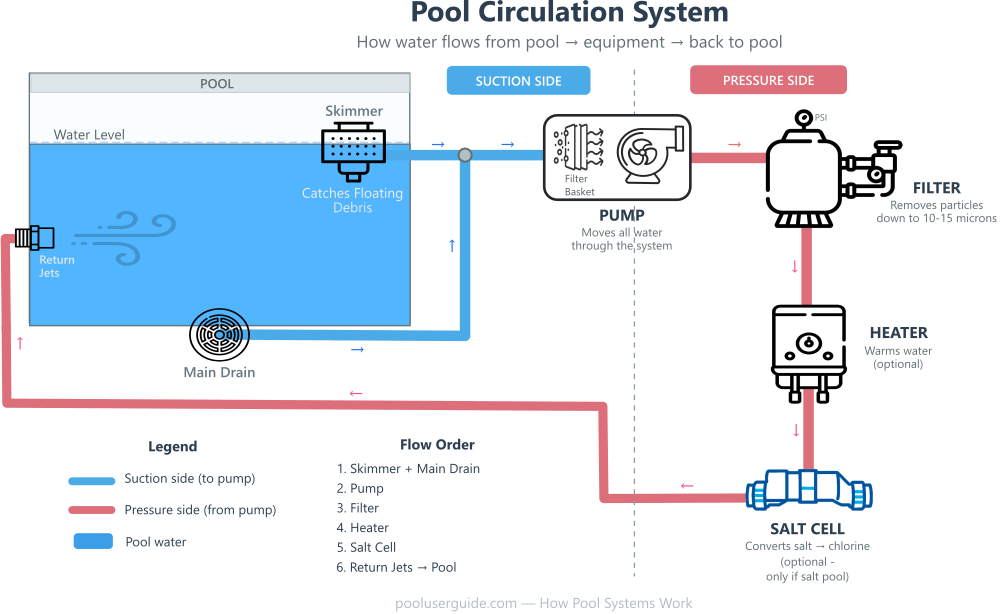
Your pool isn’t just a hole full of water. It’s a closed-loop system that constantly circulates, cleans, and treats every drop. Here’s how it works:
- Water leaves the pool through the skimmer (the rectangular opening at the waterline that catches floating debris) and the main drain (at the bottom of the deep end – you may have more than one)
- The pump pulls water from those drains through underground pipes. The water first passes through the pump’s strainer basket, which catches large debris like leaves and bugs before they reach the equipment
- Water gets pushed through the filter, which removes small particles — dirt, algae, dead skin, sunscreen — down to about 10-15 microns (smaller than a grain of sand)
- If you have a heater, water can pass through it next to warm up before returning to the pool
- If you have a salt system, water passes through the salt cell where an electrical charge converts dissolved salt into chlorine right there in the pipe
- Clean, treated water returns to the pool through the return jets (the round fittings in the pool walls where you can feel water flowing back in)
That’s the whole system. Water goes out dirty, comes back clean. The pump runs this cycle for 8-12 hours a day (depending on type of the pump, see Pool Pumps section)to turn over the entire pool volume at least once.
The 5 Core Components
| Component | What It Does | Think of It As |
|---|---|---|
| Pump | Moves water through the entire system | The heart |
| Filter | Traps dirt, debris, and particles | The lungs |
| Heater | Warms the water to your set temperature | Optional comfort upgrade |
| Sanitizer | Kills bacteria and algae (chlorine, salt cell, etc.) | The immune system |
| Return Jets | Push clean water back into the pool | The arteries |
How Long Should the Pump Run?
The general rule is to turn over your entire pool volume at least once per day. For a typical residential pool (10,000–20,000 gallons), that means 8-12 hours of pump run time.
But it’s not as simple as “run it for 10 hours.” Modern variable-speed pumps let you run at different speeds throughout the day:
- Low speed (800-1200 RPM) for general circulation – quiet and cheap to run
- Medium speed (1500-2100 RPM) for normal daily filtration
- High speed (2400+ RPM) when you need maximum flow – running the pool cleaner, clearing debris after a storm, or powering spa jets
Pro Tip: Pump energy use scales with the cube of speed. Running at half speed uses roughly 1/8 the electricity. A low setting for 12+ hours beats a high setting for 6 hours – better filtration and a lower electric bill.
The Plumbing — Suction Side vs. Pressure Side
Pool plumbers talk about two sides of the system:
- Suction side: Everything before the pump – skimmer, main drain, and the pipes pulling water from the pool. If there’s a leak here, you’ll see air bubbles in the pump basket.
- Pressure side: Everything after the pump – filter, heater, salt cell, return jets, and the pipes pushing water back to the pool. If there’s a leak here, you’ll see water spraying on the equipment pad.
Valves — The Traffic Cops
Between the pool and the equipment, you’ll find valves that control which water goes where:
- Diverter valves switch flow between pool and spa, or between skimmer and main drain
- Check valves prevent water from flowing backward (important for heaters and elevated spas)
- Shut-off valves let you isolate equipment for maintenance without draining anything
If you have a pool automation system (like Hayward OmniLogic, Pentair IntelliCenter, or Jandy iAquaLink), the valves are motorized and the system turns them automatically when you switch between pool and spa mode.
Deep Dive
Why Circulation Matters More Than You Think
A pool with perfect chemical levels but no circulation will still go green. Here’s why:
- Dead spots: Areas with little water movement become breeding grounds for algae. Behind ladders, in corners, and along the floor are common dead spots. Your return jets should be angled to push water in a circular pattern and toward the main drain.
- Chemical distribution: When you add chlorine, acid, or any chemical, circulation distributes it evenly. Without the pump running, chemicals sit concentrated in one area and the rest of the pool goes untreated.
- Surface skimming: The skimmer only works when the pump is running. Pollen, leaves, bugs, and sunscreen oils float on the surface – the skimmer can only pull them in and out of the pool when there’s active suction.
Single-Speed vs. Variable-Speed Pumps
Older pools have single-speed pumps – one speed, full blast, all the time. They work, but they’re energy hogs.
Variable-speed pumps use a permanent magnet motor (similar to what’s in an electric car) to run at any RPM you set. The energy savings are dramatic:
| Pump Type | Typical Energy Use | Annual Cost (est.) |
|---|---|---|
| Single-speed (full blast, 8 hrs/day) | ~3,000 kWh/year | $300–$800 |
| Variable-speed (mixed speeds, 12 hrs/day) | ~500–1000 kWh/year | $60–$200 |
A variable-speed pump typically pays for itself in 1-2 years through electricity savings alone. If you’re building a new pool or replacing a dead pump, variable-speed is the only option that makes sense.
💲 Cost: Variable-speed pumps run $800–$1,500 installed. Single-speed pumps are $400–$700. But the energy savings mean the variable-speed pump pays for itself over as little as 2 years.
Filter Types: Three Options
All pool filters do the same job — trap particles — but the three types do it differently:
| Filter Type | How It Works | Filtration | Maintenance |
|---|---|---|---|
| Cartridge | Water passes through pleated polyester fabric | 10–15 microns | Hose off cartridges every 4–8 weeks; replace every 3-5 years |
| Sand | Water flows through a bed of #20 silica sand | 20–40 microns | Backwash when pressure rises; replace sand every 5–7 years |
| DE (Diatomaceous Earth) | Water passes through grids coated with DE powder | 2–5 microns | Backwash + recharge with DE powder; most hands-on |
Cartridge filters are the most common on new residential pools because they’re low-maintenance and don’t require backwashing (which wastes water). Sand filters are the cheapest and simplest. DE filters produce the clearest water but need the most attention.
Sanitization: How Your Pool Stays Clean
The filter handles physical debris, but what about bacteria, viruses, and algae? That’s the sanitizer’s job. Most residential pools use one of two approaches:
Traditional Chlorine:
You manually add chlorine to the pool – either liquid chlorine (bleach), chlorine tablets (trichlor), or granular shock (calcium hypochlorite). The chlorine dissolves in the water and kills microorganisms on contact. You test the water regularly and add more as it gets used up.
Salt Water (Salt Chlorine Generator):
You add regular pool salt to the water (about 3,000–3,500 ppm – barely noticeable by taste). A salt cell installed in the plumbing uses electrolysis to convert that dissolved salt into chlorine continuously, right in the return line. You still have a chlorine pool – the difference is the system makes it for you instead of you adding it manually.
Salt systems cost more upfront ($1,000–$2,500 for the cell and control unit) but save you the ongoing hassle and cost of buying and handling chlorine. The water also feels noticeably softer.
Pro Tip: “Salt water pool” doesn’t mean no chlorine – it means the pool makes its own chlorine from salt. You still need to test and balance your water chemistry. The salt cell just automates the chlorine production part.
Pool Automation — Is It Worth It?
Modern pool automation systems let you control everything from your phone: pump speed, heater temperature, lights, spa jets, and valve positions. The major brands are:
- Hayward OmniLogic – touchscreen panel + phone app
- Pentair IntelliCenter – similar feature set, different ecosystem
- Jandy iAquaLink – another solid option
The main benefits: scheduled pump runs at different speeds throughout the day (saves electricity), one-tap “scenes” (like “Spa Night” that turns on the heater, jets, and lights), and the ability to control your pool from anywhere.
The downside? These systems add $1,500–$4,000 to a new pool build. But if you’re building new, the convenience is hard to beat. Retrofitting into an existing pool is possible but more expensive due to wiring and valve actuator installation.
FAQ
How much does it cost to run a pool?
For a typical residential pool, expect $100–$250/month in total operating costs – that’s electricity (pump is the big one), chemicals, and water. With a variable-speed pump and smart scheduling, you can keep the electricity portion under $30/month. We break this down in detail in the annual cost guide.
Can I just leave the pump off to save money?
Technically yes, but your pool will turn green within a few days in warm weather. No circulation means no filtration, no skimming, and poor chemical distribution. The pump needs to run long enough each day to circulate the entire volume of your pool at least once. With a variable-speed pump on low speed, the electricity cost is minimal.
What’s the most important piece of equipment?
The pump. Everything else depends on it. No pump, no filtration, no heating, no salt cell operation, no automatic cleaning. If your pump dies, the whole system stops. Invest in a quality variable-speed pump and it’ll run quietly for 8-12 years.