Quick Answer
pH, total alkalinity, and calcium hardness are the three pillars of pool water balance. Keep pH at 7.4–7.6 (controls comfort and chlorine effectiveness), alkalinity at 80–120 ppm (prevents pH from swinging), and calcium hardness at 200–400 ppm (protects your pool surface). Alkalinity is the foundation – adjust it first, then pH, then calcium. Get these three right and everything else gets easier.
What You Need To Know
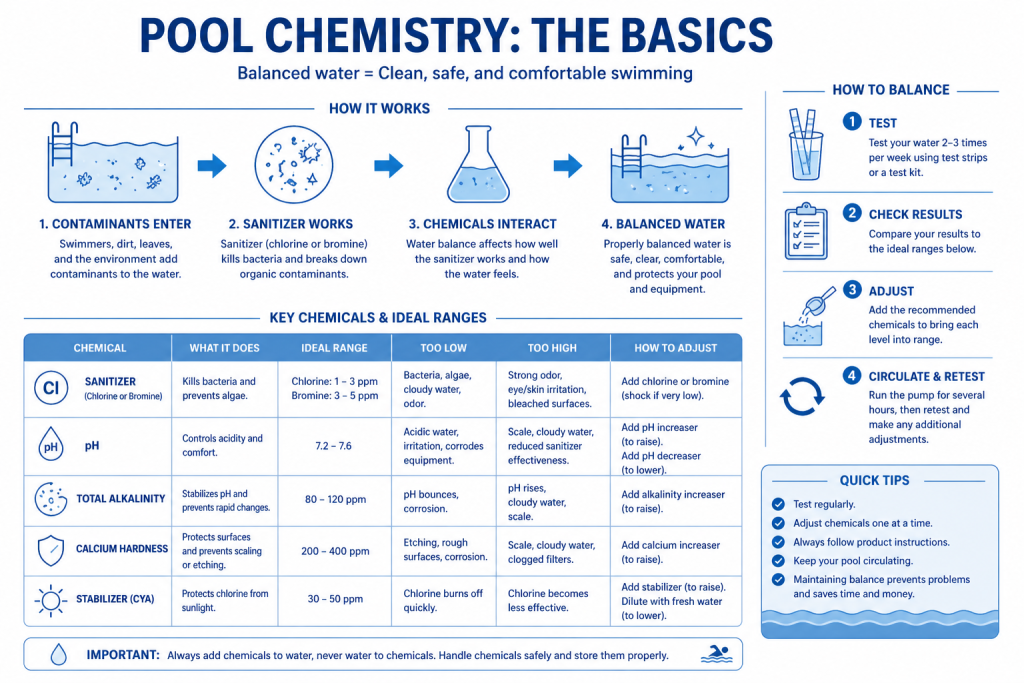
The Big Three at a Glance
| Parameter | Target Range | To Raise | To Lower | How Often to Test |
|---|---|---|---|---|
| pH | 7.2–7.6 | Soda ash (sodium carbonate) | Muriatic acid | 2-3x per week |
| Total Alkalinity | 80–120 ppm | Baking soda (sodium bicarbonate) | Muriatic acid | Weekly |
| Calcium Hardness | 200–400 ppm | Calcium chloride | Dilute (partial drain & refill) | Monthly |
The Order of Operations
Always adjust in this sequence:
- Total Alkalinity first – it’s the foundation that stabilizes everything else
- pH second – once alkalinity is in range, pH adjustments stick
- Calcium Hardness third – it changes slowly and rarely needs urgent attention
Why this order? Because alkalinity directly affects pH. If you try to fix pH while alkalinity is off, you’ll chase your tail all week. Get alkalinity right and pH becomes much more predictable.
pH – How to Adjust It
pH too high (above 7.6):
This is the most common issue. Salt systems, fresh plaster, high alkalinity, and aeration all push pH up.
- Add muriatic acid – the standard pool acid found at any pool store or hardware store
- Dosing: roughly 1 quart (32 oz) of muriatic acid per 10,000 gallons lowers pH by about 0.2 points
- Pour it along the edge of the pool with the pump running, or add it in front of a return jet for mixing
- Wait 30 minutes, retest, add more if needed
pH too low (below 7.2):
Less common, but can happen after heavy acid additions or rain.
- Add soda ash (sodium carbonate) – sold as “pH Increaser” at pool stores
- Dosing: roughly 6 oz of soda ash per 10,000 gallons raises pH by about 0.2 points
- Pre-dissolve in a bucket of pool water, pour around the pool with pump running
Pro Tip: Muriatic acid lowers both pH and alkalinity. Soda ash raises pH but also raises alkalinity. If you need to raise pH without raising alkalinity much, use aeration instead – point return jets upward if possible so they break the surface, or run a fountain/spillover feature if you have one. Aeration naturally drives pH up without affecting alkalinity.
Total Alkalinity – How to Adjust It
Alkalinity too low (below 80 ppm):
- Add baking soda (sodium bicarbonate) – yes, the same stuff from the grocery store
- Dosing: 1.5 lbs of baking soda per 10,000 gallons raises alkalinity by about 10 ppm
- Broadcast it across the pool surface with the pump running. It dissolves quickly
💲 Cost: Pool store “Alkalinity Increaser” is $15–$20 for 5 lbs. Arm & Hammer baking soda at Costco is $7 for 13.5 lbs. It’s the exact same chemical – sodium bicarbonate. Check the ingredients label.
Alkalinity too high (above 120 ppm):
- Add muriatic acid – same as for lowering pH
- To target alkalinity specifically: add acid in a single concentrated spot (pour slowly in one area of the deep end with the pump off). This affects alkalinity more than pH
- Wait 1 hour, run the pump for 30 minutes to mix, then retest
- This takes patience – you may need multiple doses over a few days
Calcium Hardness – How to Adjust It
Calcium too low (below 200 ppm):
- Add calcium chloride – sold as “Calcium Hardness Increaser”
- Dosing: 1.25 lbs per 10,000 gallons raises calcium by about 10 ppm
- Pre-dissolve in a bucket (it generates heat – add to water, not the other way around). Pour around the pool with pump running
- Never add more than 10 lbs in a single session – let it circulate for a few hours before adding more
Calcium too high (above 400 ppm):
- There’s no chemical to remove calcium. The only option is to partially drain and refill with fresh water
- If your fill water is already high in calcium (common in some parts of the US, especially the Southwest), you may need to accept calcium on the higher end or use a hose-end filter when filling
Deep Dive
pH – Why 7.4-7.6 Matters So Much
The pH of your pool water affects two critical things:
1. Chlorine effectiveness
Chlorine’s killing power drops dramatically as pH rises:
| pH Level | % of Chlorine That’s Active |
|---|---|
| 7.0 | ~73% |
| 7.2 | ~63% |
| 7.4 | ~52% |
| 7.6 | ~33% |
| 7.8 | ~22% |
| 8.0 | ~15% |
At pH 8.0, you’d need roughly 5x more chlorine to get the same sanitizing power as at pH 7.2. This is why pH matters more than most people realize. Keeping it at 7.4-7.6 is the sweet spot: chlorine is effective, swimmers are comfortable, and the water isn’t aggressive to equipment.
2. Swimmer comfort
Human eyes and mucous membranes have a natural pH of about 7.4. Water that’s too far from this – in either direction – causes eye irritation, dry skin, and discomfort. When people say “too much chlorine makes my eyes burn,” the real culprit is almost always pH being off, not the chlorine level.
Total Alkalinity – The pH Stabilizer
Think of alkalinity as your water’s resistance to pH change. With proper alkalinity (80-120 ppm), pH changes slowly and predictably. With low alkalinity, pH can swing wildly from a single rain shower or chemical addition – a condition called “pH bounce.”
What causes low alkalinity:
- Heavy rain (rainwater has very low alkalinity)
- Over-acidifying (adding too much muriatic acid)
- Source water with naturally low alkalinity
What causes high alkalinity:
- Fill water in limestone/hard water areas (common in Texas and the Southwest)
- Adding too much baking soda
- Certain pool chemicals (some shock products raise alkalinity)
The relationship between alkalinity and pH:
This is the part that confuses people. Alkalinity and pH are linked but not the same thing. Muriatic acid lowers both. Soda ash raises both. Baking soda raises alkalinity more than pH. Aeration raises pH without affecting alkalinity.
If you need to lower alkalinity without crashing pH: add acid, let alkalinity come down, then aerate to bring pH back up (point returns upward, run fountains, or run a spa spillover). This takes a few cycles but works.
Calcium Hardness – Protecting Your Pool Surface
Water naturally wants to contain a certain amount of dissolved minerals. If your water is low in calcium (“soft water”), it becomes aggressive — it’ll dissolve calcium from your plaster, grout, tile, and even concrete decking to satisfy its mineral demand. This is called etching and it destroys pool finishes.
If your water is too high in calcium (“hard water”), the excess precipitates out as white, crusty scale deposits on tile, inside pipes, in the heater, and on the salt cell.
Example: Houston-area tap water typically runs 50–150 ppm calcium. You’ll likely need to add calcium chloride after filling or after heavy rain dilution. If you’re in Arizona or Southern California, your fill water may already be 300+ ppm and you’ll fight the high end instead. Testing is key.
The Saturation Index (LSI) – Advanced
For those who want the complete picture, there’s a formula called the Langelier Saturation Index (LSI) that combines pH, alkalinity, calcium hardness, water temperature, and TDS into a single number:
- LSI = 0 – perfectly balanced water. Neither corrosive nor scale-forming
- LSI negative – water is corrosive (dissolving surfaces)
- LSI positive – water is scale-forming (depositing minerals)
- Target: -0.3 to +0.3
You don’t need to calculate LSI weekly – it’s more of a quarterly check. Several free apps and websites calculate it from your test results (Pool Math by Trouble Free Pool is a good one). If you keep the Big Three in their target ranges, your LSI will generally be fine.
Pro Tip: Water temperature affects LSI more than most people realize. In Texas summers, pool water hits 90°F+. Warm water is more scale-prone, so you can let calcium run toward the lower end of the range (200-250 ppm) during summer and be fine. In winter, when water cools down, the same calcium level might make water slightly corrosive. Seasonal adjustments aren’t critical for most pools, but it’s good to know why your water behaves differently in July vs. January.
FAQ
Why does my pH keep going up?
Several things push pH upward: salt chlorine generators (the electrolysis process raises pH), fresh plaster surfaces (for the first 6-12 months), high alkalinity, aeration from water features, and degassing of CO2 in warm weather. If you have a salt pool, expect to add a small amount of muriatic acid almost weekly – this is normal.
Is baking soda really the same as Alkalinity Increaser?
Yes. Check the active ingredient on any pool store “Alkalinity Increaser” – it’s sodium bicarbonate. That’s baking soda. Arm & Hammer from Costco works identically at a fraction of the price. The pool store version sometimes has slightly larger granules for easier broadcasting, but the chemistry is identical.
My calcium hardness is at 150 ppm. Is that urgent?
Not immediately dangerous, but over months, water at 150 ppm can slowly etch plaster surfaces and degrade grout. Add calcium chloride to bring it into the 200-300 ppm range. If you have a pebble or tile finish, you have more time than someone with white plaster.