
Quick Answer
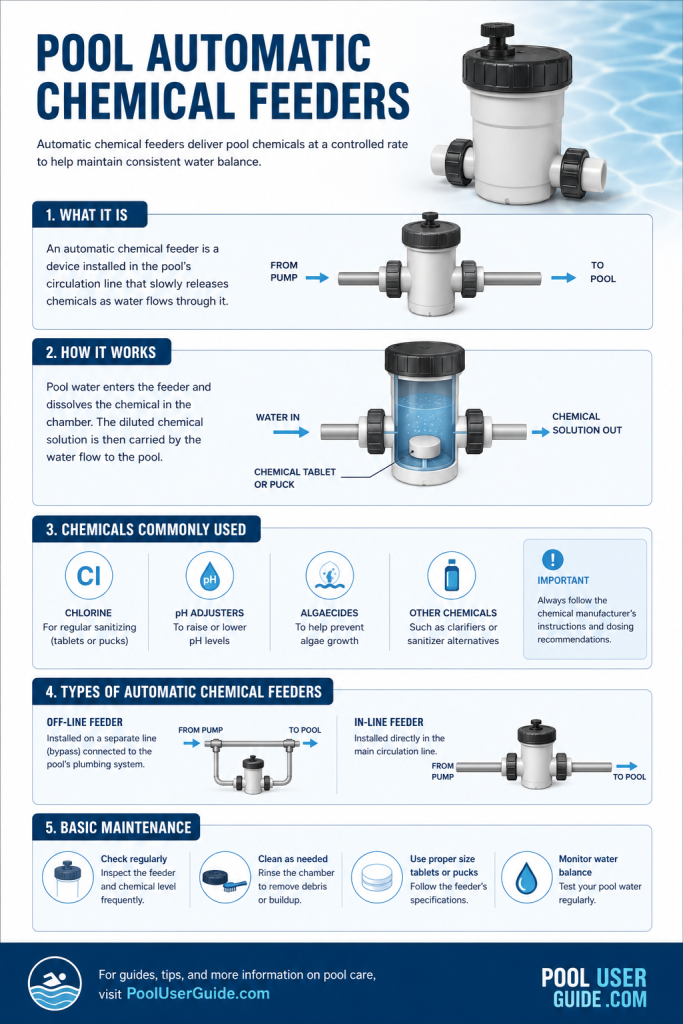
Automatic chemical feeders dispense chlorine (tablets) or other chemicals into your pool water at a controlled rate – so you don’t have to manually add chemicals every day. The most common type is an inline or offline tablet feeder (also called a chlorinator) that slowly dissolves 3-inch trichlor tablets. More advanced options include liquid chemical feeders (peristaltic pumps) and smart chemical controllers that test the water and dose automatically. For most pool owners, a simple tablet feeder is all you need.
What You Need to Know
- Tablet feeders are the most common – they hold 3-inch trichlor tablets and dissolve them slowly as water flows through
- Inline feeders plumb directly into your return line; offline feeders connect via separate tubing (easier to add to existing systems)
- Chlorine tablets contain CYA (cyanuric acid) – this builds up over time and can become a problem. This is the main downside of tablet feeders.
- Liquid feeders (peristaltic pumps) dispense liquid chlorine or muriatic acid – no CYA buildup, but more complex and expensive
- Smart controllers test the water continuously and dose chemicals automatically – the ultimate in pool automation, but cost $1,000–$3,000+
Types of Automatic Chemical Feeders
1. Tablet Chlorinators (Inline and Offline)
The workhorse of pool chemical automation. You load 3-inch trichlor tablets into a canister, and the feeder dissolves them at a controlled rate as pool water flows through.
| Feature | Inline Chlorinator | Offline Chlorinator |
|---|---|---|
| Installation | Cut into the return plumbing line | Connects via small tubes off the main plumbing |
| Best for | New pool builds or major plumbing work | Adding to existing pool without cutting plumbing |
| Flow | Full water flow passes through | Only a small bypass of water flows through |
| Tablet capacity | 5–9 tablets depending on model | 5–9 tablets depending on model |
| Cost | $80–$200 | $80–$200 |
| Brands | Hayward CL200/CL220, Pentair Rainbow 320 | Hayward CL100/CL110, Pentair Rainbow 300 |
How to Use a Tablet Chlorinator
- Turn off the pump before opening the feeder lid
- Open the feeder lid – twist counterclockwise. Release pressure if there’s a bleed valve.
- Load 3-inch trichlor tablets – stack them in the canister (typically 5–9 tabs depending on size)
- Close the lid snugly – make sure the O-ring is in good condition
- Adjust the dial/flow ring – this controls how much water flows through the tablets, which controls the dissolution rate:
- Higher setting = more water flow = faster dissolution = more chlorine
- Lower setting = less water flow = slower dissolution = less chlorine
- Turn the pump back on and check for leaks around the lid
- Test the pool water after 24 hours and adjust the dial as needed
Tablet Chlorinator Maintenance
| Task | Frequency | Details |
|---|---|---|
| Refill tablets | Every 1–2 weeks | Check tablet level; refill when low |
| Inspect lid O-ring | Monthly | Lube with silicone pool lube; replace if cracked or flat |
| Clean interior | Quarterly | Remove any tablet residue or sludge; rinse with hose |
| Check for leaks | Monthly | Look for drips around lid, fittings, or tubing connections |
| Test CYA level | Monthly | Monitor for CYA buildup from tablets |
2. Floating Chlorine Dispensers
The simplest “automatic” feeder -a plastic float that holds 1–3 tablets and drifts around the pool. Not truly automatic (no control over dissolution rate), but they work for small or above-ground pools.
Pros: Cheap ($5–$15), no installation, dead simple.
Cons: No precise control; can get trapped in one spot and bleach the surface; looks messy; tips over and dumps tablets.
3. Liquid Chemical Feeders (Peristaltic Pumps)
These are small chemical-resistant pumps that inject liquid chemicals directly into your return line through a small injection fitting. They’re used for:
- Liquid chlorine (sodium hypochlorite)– no CYA buildup, precise dosing
- Muriatic acid – automated pH control
| Feature | Details |
|---|---|
| How it works | A peristaltic (roller) pump squeezes tubing to push liquid chemical from a storage container through an injection fitting into the plumbing |
| Control | By timer, or paired with a chemical controller for demand-based dosing |
| Cost | $200–$600 per pump; $50–$100/year for tubing replacement |
| Brands | Stenner, Blue-White, Rola-Chem |
| Best for | Pool owners who want to use liquid chlorine exclusively (avoid CYA buildup); automated pH management |
Pros: Precise dosing; no CYA buildup (when using liquid chlorine); can automate pH management; compatible with chemical controllers.
Cons: More complex setup; need to store liquid chemicals (chlorine degrades over time); tubing needs periodic replacement; higher cost.
4. Smart Chemical Controllers
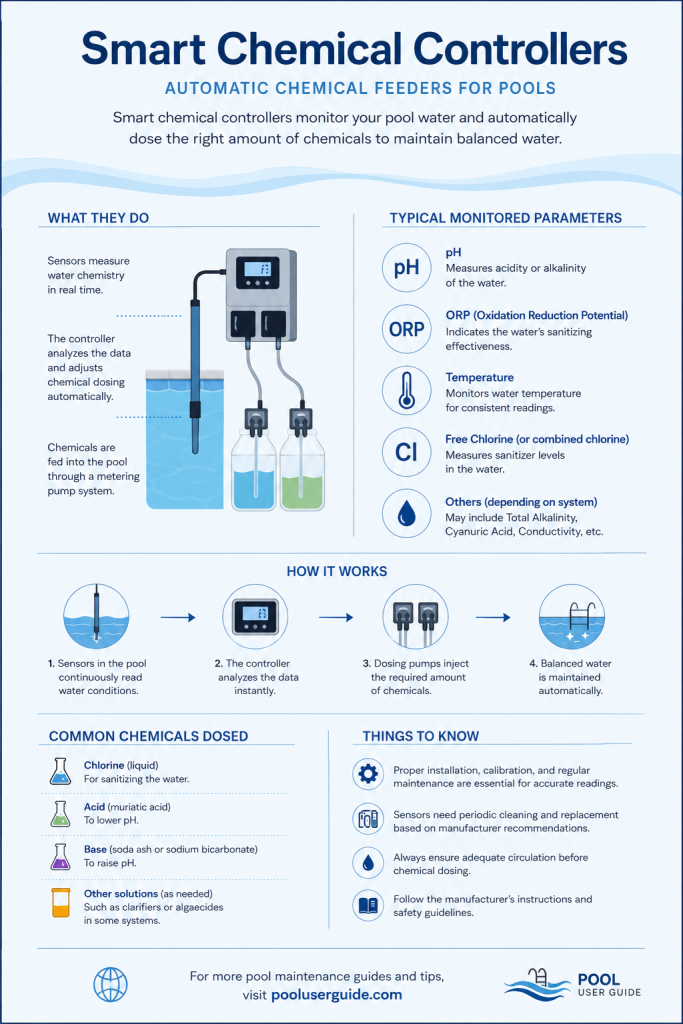
The top tier of pool chemical automation. These systems continuously test your water and automatically dose chemicals to maintain perfect balance.
| Feature | Details |
|---|---|
| How it works | pH and ORP (chlorine) sensors in the plumbing continuously measure water chemistry. The controller activates chemical feed pumps to dose when levels drift out of range. |
| What it controls | pH (via muriatic acid feed) and chlorine (via liquid chlorine feed or SWG output adjustment) |
| Cost | $1,000–$3,000+ for the controller; $200–$600 per chemical feed pump; sensors need annual replacement ($100–$200 each) |
| Brands | Hayward CAT 4000, Pentair IntelliChem, Rola-Chem Controllers, AutoPilot Total Control |
| Best for | Pool owners who want near-zero manual chemical management; commercial pools; high-end residential automation |
What Is ORP?
ORP stands for Oxidation-Reduction Potential – it’s a measurement (in millivolts) of the water’s overall oxidizing power. Higher ORP = more sanitizing power. Most controllers target 650–750 mV ORP, which corresponds to adequate free chlorine levels. ORP is not the same as free chlorine ppm – it’s affected by pH, CYA, temperature, and other factors — but it’s a useful real-time proxy for sanitization effectiveness.
Which Feeder Is Right for You?
| If you… | Best option |
|---|---|
| Want simple, low-cost automation | Inline or offline tablet chlorinator |
| Have a small or above-ground pool | Floating dispenser (or small offline chlorinator) |
| Want to avoid CYA buildup from tablets | Liquid chlorine feeder (peristaltic pump) |
| Have a salt pool | Salt chlorine generator (not a traditional feeder) – see our SWG guide |
| Want pH + chlorine fully automated | Smart chemical controller + feed pumps |
| Travel often and leave pool unattended | Tablet chlorinator (minimum) or smart controller (ideal) |
| Already use liquid chlorine and want to automate delivery | Peristaltic pump + timer (or with chemical controller) |
Safety and Best Practices
- Never mix different types of chlorine – trichlor tablets + calcium hypochlorite (granular shock) can cause a fire or explosion. Use separate containers and never put different products in the same feeder.
- Never put trichlor tablets in the skimmer basket – when the pump is off, concentrated acid from dissolving tablets can corrode your pump, heater, and plumbing. Always use a proper feeder or floating dispenser.
- Wear gloves and eye protection when handling tablets and especially when handling muriatic acid.
- Store chemicals in original containers in a cool, dry, ventilated area away from each other.
Tablet Selection Tips
- Use only 3-inch stabilized (trichlor) tablets in automatic feeders- not 1-inch tabs, not calcium hypochlorite (cal-hypo), not dichlor granules
- Buy name-brand tablets (In The Swim, Clorox Pool, HTH) – cheap off-brand tablets may dissolve unevenly or contain more binder material
- Never mix old and new tablets from different brands in the same feeder if possible- different formulations can react
- Store tablets in their original sealed bucket – exposure to moisture or heat accelerates degradation
Troubleshooting Chemical Feeders
| Problem | Likely Cause | Fix |
|---|---|---|
| Chlorine level too low | Dial set too low; not enough tablets; high chlorine demand (sun, swimmers, algae) | Turn dial up; add more tablets; test and address underlying demand |
| Chlorine level too high | Dial set too high; too many tablets; pump running longer than usual | Turn dial down; reduce tablets; let levels drop naturally (don’t swim until below 5 ppm) |
| Feeder leaking | Bad lid O-ring; cracked canister; loose fittings | Replace O-ring; inspect canister for cracks; tighten fittings |
| Tablets not dissolving | Dial set too low; clogged flow path; pump not running enough | Open dial; clean interior of residue; check pump schedule |
| CYA keeps rising | Normal when using trichlor tablets – every tab adds CYA | Monitor CYA; switch to liquid chlorine if CYA exceeds 70-80 ppm; lower CYA by partial drain |
| Peristaltic pump not dosing | Worn tubing; air lock; empty chemical container; clogged injection fitting | Replace tubing; prime pump; refill chemical; clean injection fitting |
Frequently Asked Questions
Can I put tablets directly in my skimmer?
No. This is one of the most common pool maintenance mistakes. When the pump shuts off, dissolved trichlor sits in your plumbing as concentrated acid – corroding the pump, heater, and pipes. Always use a proper feeder (inline, offline, or floating).
How many tablets do I need per week?
As a rough guide: 1 tablet per 5,000 gallons per week during summer. A 15,000-gallon pool might use 3 tablets per week. This varies significantly with sunlight exposure, temperature, bather load, and CYA level. Adjust based on actual chlorine readings.
Should I use tablets or liquid chlorine?
Tablets are more convenient (set and forget for 1–2 weeks). Liquid chlorine gives more precise control and doesn’t add CYA. Many experienced pool owners use both – a tablet feeder at a low setting for baseline chlorine, plus liquid chlorine as needed for boosts and shocking. See our chlorine guide for a full comparison.
Are chemical controllers worth it for a home pool?
For most homeowners, no – a tablet feeder or salt system plus weekly manual testing is sufficient. Chemical controllers make sense if you: travel frequently, absolutely hate testing water, have a large or heavily-used pool, or already have a high-end automation system and want to complete the setup.
Can I automate pH control without a full chemical controller?
Yes. A standalone acid feed pump on a timer can dispense muriatic acid at set intervals. This isn’t as precise as a controller with a pH sensor, but it can help if your pH consistently rises (common in salt pools). Just be careful – over-acidification can damage your pool surface and equipment.
Related Pages
- Chlorine Guide — Understanding the chlorine types used in automatic feeders
- How to Lower CYA – Dealing with CYA buildup from trichlor tablets
- Salt Chlorine Generators -The alternative to chemical feeders for chlorine
- How to Balance Your Pool Water – The chemistry your feeder helps maintain
- Pool Maintenance Costs – Chemical costs in your monthly budget