
Quick Answer
Chlorine is your pool’s sanitizer – it kills bacteria, viruses, and algae. Use liquid chlorine (sodium hypochlorite) as your primary sanitizer for the most control, and keep your free chlorine level based on your CYA: generally 2-5 ppm for most residential pools with CYA of 30-50 ppm. Add chlorine in the evening to minimize UV loss. Shocking means temporarily raising chlorine to 10x your normal level to destroy organic buildup. 3-inch tabs work for vacation maintenance but add CYA over time, which creates its own problems.
What You Need To Know
Types of Chlorine Products
Not all chlorine is the same. Each product has different strengths, side effects, and best uses:
| Product | Chlorine % | Adds CYA? | pH Effect | Best Use |
|---|---|---|---|---|
| Liquid chlorine (sodium hypochlorite) | 10-12.5% | No | Raises pH slightly | Daily/regular chlorination – the #1 recommendation |
| 3-inch stabilized tabs (trichlor) | ~90% | Yes | Lowers pH | Vacation/travel when you can’t add liquid daily |
| Cal-hypo granular shock | ~65-73% | No | Raises pH | Shock treatments (adds calcium – caution in hard water areas) |
| Dichlor granular | ~56% | Yes | Nearly neutral | Spa sanitization, spot treatments |
| Household bleach | 6-8.25% | No | Raises pH slightly | Emergency backup – works but costs more per unit of chlorine |
Why Liquid Chlorine Is the Best Choice
Three reasons:
- No CYA buildup – Tabs (trichlor) add 0.6 ppm of CYA for every 1 ppm of FC they provide. Over a season, that drives CYA to 100+ ppm, which forces you to maintain higher and higher chlorine levels to stay effective. Liquid chlorine adds zero CYA.
- Precise dosing – Pour exactly what you need. Tabs dissolve at their own pace regardless of what your pool actually needs.
- Cheap and available – Pool-strength liquid chlorine (10-12.5%) is $4-6/gallon at pool stores, hardware stores, and even Walmart. In a pinch, regular unscented bleach works too (just weaker concentration).
💲 Cost: A 10,000-gallon pool in a sunny climate uses roughly 1-2 gallons of liquid chlorine per week during summer. That’s $4-12/week. Tabs cost about the same per week but add CYA that eventually forces a partial drain — which costs $50-150 in water. Liquid chlorine wins on total cost.
How to Add Liquid Chlorine
- Calculate how much you need (see dosing table below or use a pool calculator app)
- Wait until evening — adding chlorine after sunset means no UV burn-off overnight
- With the pump running, pour the liquid chlorine slowly around the perimeter of the pool
- Or pour it in front of a return jet for faster dispersal
- Do NOT pour it into the skimmer (concentrated chlorine near the pump can damage gaskets)
- Wait at least 30 minutes before swimming
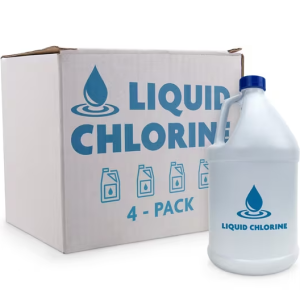
Liquid Chlorine Dosing Table
Using 12.5% sodium hypochlorite (pool-store strength):
| Pool Size | Raise FC 1 ppm | Raise FC 2 ppm | Raise FC 5 ppm |
|---|---|---|---|
| 5,000 gallons | 5 oz | 10 oz | 25 oz |
| 10,000 gallons | 10 oz | 20 oz | 50 oz |
| 15,000 gallons | 15 oz | 30 oz | 75 oz |
| 20,000 gallons | 20 oz | 40 oz | 100 oz |
| 30,000 gallons | 30 oz | 60 oz | 150 oz |
For 10% chlorine (retail bleach), increase amounts by about 25%.
Deep Dive
How Chlorine Actually Works
When you add liquid chlorine to your pool, it dissolves into two forms:
- Hypochlorous acid (HOCl) – the active, killing form. This is what destroys bacteria, viruses, and algae
- Hypochlorite ion (OCl⁻) – the inactive form. It’s still “free chlorine” on your test kit, but it doesn’t sanitize effectively
The ratio between these two forms depends entirely on pH:
- At pH 7.2: roughly 63% is HOCl (active)
- At pH 7.5: roughly 50% is HOCl
- At pH 8.0: only 21% is HOCl
This is why pH management isn’t optional – at pH 8.0, you’d need almost 3x as much chlorine to kill the same germs as at pH 7.2. Keeping pH at 7.4-7.6 gives you the best balance of sanitizing power and swimmer comfort.
Understanding Free Chlorine, Combined Chlorine, and Total Chlorine
Your test kit measures these values:
- Free Chlorine (FC): The good stuff – chlorine that’s available to sanitize. This is the number you manage.
- Combined Chlorine (CC): “Used” chlorine – chloramines that have bonded with nitrogen compounds (sweat, urine, body oils, leaves, pollen). This is what causes the “chlorine smell” and eye irritation. Calculated as CC = TC – FC.
- Total Chlorine (TC): FC + CC combined. Your test kit measures this directly.
If CC is above 0.5 ppm, it’s time to shock.
What Is Shocking and When to Do It
“Shocking” means temporarily raising your free chlorine to a high level – typically 10x your minimum FC, or to at least 30% of your CYA — to break apart (oxidize) built-up organic matter, chloramines, and any early-stage algae.
When to shock:
- Combined chlorine above 0.5 ppm
- After a heavy-use pool party
- After heavy rain
- Green or cloudy water – indicates algae growth
- Opening the pool for the season
- Strong chlorine smell (paradoxically means you need MORE chlorine, not less)
How to shock with liquid chlorine:
- Calculate your target shock level: CYA × 0.4 (rounded up). If CYA is 40, target FC = 16 ppm
- Test current FC
- Calculate how much liquid chlorine to add to reach the target (use the dosing table or Pool Math app)
- Add the full amount all at once, in the evening, with the pump running
- Run the pump continuously until FC drops back to your normal target (usually 12-24 hours)
- Do NOT swim until FC drops below 10 ppm (ideally below 5 ppm)
Pro Tip: You do NOT need special “shock” products. Liquid chlorine from the pool store or even unscented bleach works perfectly for shocking. “Pool shock” products are just concentrated chlorine (usually cal-hypo) — they work, but they also raise calcium hardness and pH. Liquid chlorine is simpler.
The CYA / Chlorine Relationship Explained
Cyanuric acid (CYA) bonds with free chlorine, protecting it from UV destruction. Think of CYA as tiny umbrellas over your chlorine molecules — great on a sunny day, but if you have too many umbrellas, the chlorine can’t get out from under them to do its job.
How CYA changes chlorine’s effectiveness:
- With CYA at 0 ppm – chlorine is fully active but gets destroyed by UV in 1-2 hours. Impractical for outdoor pools.
- With CYA at 30 ppm – chlorine is protected from UV and still very effective. Sweet spot for chlorine-dosed pools.
- With CYA at 50 ppm – still fine, especially for salt pools. You need slightly higher FC.
- With CYA at 100+ ppm – chlorine is so tightly bound that you need 8+ ppm FC minimum to prevent algae. This is the “CYA trap” from over-using tabs.
How CYA builds up:
- 3-inch tabs (trichlor) add about 0.6 ppm CYA for every 1 ppm FC they provide
- Over a full summer of tab use, CYA can easily reach 80-150 ppm
- CYA does NOT degrade, evaporate, or get filtered out – it only leaves through water replacement
If your CYA is already above 50 ppm (above 80 ppm for salt pools), see How to Lower Cyanuric Acid.
When Tabs Make Sense
Despite the CYA issue, tabs have legitimate uses:
- Vacations: Going out of town for a week? Tabs in a floater provide slow, continuous chlorine. Just know that CYA will rise while you’re gone.
- Brand new pool with 0 CYA: Tabs can build up your CYA to the target 30-40 ppm range — then switch to liquid chlorine to maintain.
- Pools with inline tab feeders – convenient for hands-off owners who don’t want to pour liquid chlorine every day.
If you do use tabs, monitor CYA every month and switch to liquid chlorine once CYA hits your target. Don’t let CYA climb above 50 ppm for a chlorine pool or 80 ppm for a salt pool.
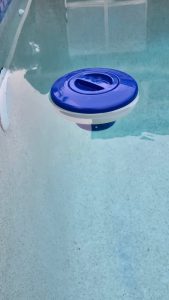
A common way to deploy chlorine tablets is with a floating Chlorine dispenser (holds about three 3 inch tabs)
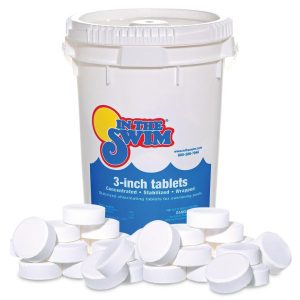
Chlorine tabs are 3 inch chalky pucks that usually come in a big tub. Handle all chlorine products with gloves.
Chlorine Safety
Chlorine is a strong oxidizer. Handle it with respect:
- Liquid chlorine: Wear old clothes (it bleaches fabric on contact), gloves, and eye protection. Pour carefully – don’t splash. If it gets in your eyes, flush with water immediately for 15+ minutes.
- Tabs and granular products: Keep tightly sealed and in a cool, dry place. NEVER mix different chlorine products in the same container. Mixing trichlor tabs with cal-hypo granules can cause fire or explosion.
- Never add chlorine and muriatic acid at the same time – this produces chlorine gas, which is extremely toxic.
- Store chemicals in original containers – no transferring to unlabeled bottles.
- Keep all pool chemicals away from children and pets.
FAQ
Can I use regular household bleach instead of pool chlorine?
Yes. Regular unscented bleach (Clorox, Great Value, etc.) is sodium hypochlorite – the same chemical as liquid pool chlorine, just at a lower concentration (6-8.25% vs. 10-12.5%). You’ll need roughly twice as much bleach to get the same chlorine dose. It works fine in a pinch or as your regular sanitizer. Just make sure it’s unscented with no additives – no “splashless,” no “with Clorox 2,” no fragrance.
Why does my pool have a strong chlorine smell even though FC reads low?
That “chlorine smell” is actually chloramines (combined chlorine), not free chlorine. It means you need to shock – add a large dose of chlorine to break apart the chloramines. A properly chlorinated pool should have almost no smell.
How long after adding chlorine can we swim?
After regular dosing: wait at least 30 minutes with the pump running for the chlorine to disperse. After shocking: do not swim until FC drops below 5 ppm (test to confirm). This usually takes 8-24 hours depending on how high you shocked and how much UV the pool gets.
My chlorine disappears overnight. What’s going on?
Several possibilities: (1) CYA is too low – UV is destroying the chlorine. Check CYA and add stabilizer if below 30 ppm. (2) You have a chlorine demand – something in the water is consuming chlorine (early algae, organic matter, metals). Shock the pool to overcome the demand. (3) Undersized salt cell if using a salt system.
My chlorine disappears during the day but holds overnight. Normal?
That’s UV degradation and usually means your CYA is too low. Sunlight destroys unprotected chlorine in just a couple hours. Add cyanuric acid to 30-40 ppm and the daytime loss will slow dramatically.
Is there such a thing as too much chlorine?
For swimming comfort, anything above 10 ppm FC can irritate skin and eyes. For your pool surfaces and equipment, prolonged FC above 10-15 ppm can accelerate wear on gaskets, seals, and vinyl liners. After shocking, let FC drop back to normal range before swimming. For daily maintenance, there’s no practical “too high” within the ranges on the FC/CYA chart – those levels are safe.