
Quick Answer
There are three types of automatic pool cleaners: suction-side, pressure-side, and robotic. Suction-side cleaners come included with many new pool builds and are the most common starter cleaners. Pressure-side cleaners handle heavy debris and have their own bag. Robotic cleaners are self-contained and do the best overall job but cost the most. This guide covers all three in depth so you can get the most out of whatever type you have.
What You Need to Know
- Suction-side cleaners connect to your skimmer or a dedicated suction port and are powered by your pool pump. They are the most common type found on new pool builds.
- Pressure-side cleaners connect to your return jet and use water pressure to move around and collect debris into their own bag. Some require a booster pump.
- Robotic cleaners are completely independent. They plug into a wall outlet and have their own motor, pump, and filter inside the unit.
- All three types handle the floor automatically. Wall and waterline coverage depends on the specific model.
- None of them replace brushing and skimming entirely, but they significantly reduce how often you need to do it manually.
The Three Types: At a Glance
| Feature | Suction-Side | Pressure-Side | Robotic |
|---|---|---|---|
| How it connects | Skimmer or dedicated suction port | Return jet or dedicated pressure line | Plugs into 110V wall outlet |
| What powers it | Your pool pump | Your pump (or a booster pump) | Its own internal motor |
| Where debris goes | Into your pump basket and filter | Into its own attached bag | Into its own internal filter |
| Price range | $200–$500 | $400–$800 (add $400+ for booster pump if needed) | $500–$1,500+ |
| Cleaning quality | Good (floor focused) | Good (floor and some walls) | Excellent (floor, walls, waterline) |
| Scrubbing | Minimal | Some models | Active rotating brushes |
| Filter wear | High (all debris passes through filter) | Low (debris stays in bag) | None (independent system) |
| Installation | DIY, plug into skimmer | DIY or professional (booster pump) | DIY, just plug in and drop in pool |
| Best for | Most pools, tight budgets, already included in many builds | Pools with heavy leaf and debris load | Best overall performance, hands-off cleaning |
Suction-Side Pool Cleaners
Suction-side cleaners are the most common automatic pool cleaner, and for good reason. They are simple, reliable, relatively cheap, and often included with new pool builds. If you have a cleaner that connects to your skimmer or a dedicated suction port with a hose, this is what you have.
How They Work
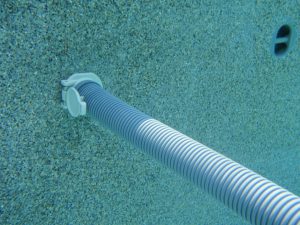
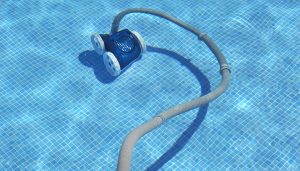
The cleaner attaches to your skimmer (or a dedicated suction port in the pool wall) via a series of hose sections. Your pool pump creates suction, which pulls the cleaner across the floor in a random or semi-guided pattern. As it moves, it vacuums up debris through the hose and into your pump basket and filter.
Most suction cleaners move by a combination of the water flow and a diaphragm or flapper mechanism inside the unit that creates a pulsing motion. This is what makes the characteristic “thump thump” sound you hear when one is running.
Who It Is For
- New pool owners who received one with their pool build
- Owners with moderate debris loads (no heavy trees surrounding the pool)
- Anyone who wants set-it-and-forget-it cleaning without the cost of a robotic unit
- Pools with a variable speed pump running at a consistent speed during cleaning cycles
Setup and Installation
- Connect the hose sections to reach from the skimmer to the far end of your pool. Most cleaners come with enough hose sections. Lay them out in the sun for 15 minutes first so they straighten out and are easier to work with.
- Connect to the skimmer using the provided skimmer plate, which replaces your normal skimmer basket cover. This redirects suction from the skimmer basket to the cleaner hose. Alternatively, if your pool has a dedicated suction port (a second fitting near the bottom of the wall), use that instead to keep your skimmer free for surface debris.
- Drop the cleaner in the pool and let the hose fill with water before turning the pump on. Air in the hose causes the cleaner to move erratically.
- Set your pump speed. Most suction cleaners work best at 2,000–2,500 RPM on a variable speed pump. Too slow and the cleaner does not move well. Too fast and it moves too aggressively, gets stuck on walls, and the diaphragm wears out faster. Check your cleaner’s manual for the recommended flow rate.
- Adjust the hose length if needed. The hose should let the cleaner reach every part of the pool but not have so much slack that it tangles. A general guide: the hose should reach the farthest point of your pool plus about 1 foot.
How to Get Better Coverage
Suction cleaners move in a random pattern, which means they sometimes miss spots or get stuck in corners. A few things that help:
- Adjust the flow regulator (the disc inside the hose connector at the skimmer). Opening it more reduces flow and slows the cleaner down, which can improve coverage in large pools.
- Add a hose weight midway down the hose. This keeps the hose on the floor and prevents it from rising and creating loops that interfere with movement.
- Use a leaf canister. If your pool gets leaves or large debris, a leaf canister inline on the hose catches debris before it reaches your pump basket. This saves you from constantly emptying the pump basket and protects the pump from clogging. It’s a worthwhile $30–$50 upgrade for any pool with nearby trees.
Popular Suction-Side Cleaner Models
| Model | Price | Best For | Notes |
|---|---|---|---|
| Hayward SmartVac Ultra | $200–$280 | Most in-ground pools | Very popular, reliable, good parts availability, common in new builds |
| Pentair Rebel | $300–$400 | In-ground pools, gunite surfaces | Microban-treated hose, good on rough surfaces |
| Zodiac T5 Duo | $350–$450 | Large pools with debris | Two-chamber system catches more debris before it reaches the pump |
| Hayward Poolvergnuegen (PoolVac) | $250–$350 | Most in-ground and above-ground pools | Self-adjusting turbine, works over a wide range of pump speeds |
Maintenance
| Task | Frequency | Details |
|---|---|---|
| Empty pump basket | 2–3x per week when running | A clogged pump basket reduces suction and the cleaner stops moving well |
| Inspect diaphragm or flapper | Monthly | The diaphragm is the most common wear part. Replace when cracked, torn, or when the cleaner loses its pulsing motion. Costs $10–$20. |
| Check hose connections | Monthly | Air leaks in hose connections cause erratic movement. Squeeze each connection to confirm it is snug. |
| Inspect hose sections | Seasonally | UV-damaged hoses become brittle and crack. Replace any that have visible cracks. |
| Check the wheel/foot pads | Seasonally | Worn contact surfaces reduce traction on the pool floor. |
| Backwash or clean your filter | More often when using suction cleaner | All debris passes through the filter, so it loads up faster. |
Parts are cheap and widely available. The diaphragm, flapper, and hose sections are the only parts that commonly need replacing. For most popular models you can find a parts kit for $20–$40 that includes everything likely to wear out in a season.
Pressure-Side Pool Cleaners
Pressure-side cleaners connect to your return line instead of the suction side. Water pressure from your pump (or a dedicated booster pump) propels the cleaner around the pool and blows debris into a bag attached to the unit. Because debris goes into the cleaner’s own bag rather than through your filter, pressure-side cleaners are easy on your filtration system and handle larger debris like leaves and acorns well.
How They Work
A pressure-side cleaner connects to a dedicated pressure fitting (installed in the pool wall) or adapts directly to one of your return jets. Pressurized water from the pump enters the cleaner and does two things: it propels the unit through a series of jets, and it creates a venturi effect that captures debris into the attached bag. Some models use a separate booster pump to maintain consistent pressure independent of your main pump’s speed.
Booster Pump: Do You Need One?
This is the key question with pressure-side cleaners. Some models require a dedicated booster pump, others work off your main pump alone.
| Cleaner Type | Examples | Booster Pump | Notes |
|---|---|---|---|
| Booster-required models | Polaris 280, 380, 3900 Sport | Required (Polaris PB4-60) | Best performance; booster pump adds $400–$500 installed |
| No-booster models | Polaris 65, 360, Pentair Racer | Not required | Use your main pump’s return pressure; less powerful but no extra equipment |
If you are considering a pressure-side cleaner from scratch, check with your pool builder or the manufacturer’s flow rate requirements before buying. Your main pump needs to produce enough pressure at the return fitting for the cleaner to work properly.
Who It Is For
- Pools surrounded by trees with heavy leaf and debris fall
- Owners who want to keep debris out of the filter entirely
- Pools that already have a booster pump installed (common with older Polaris installations)
Popular Pressure-Side Models
| Model | Price | Booster Needed | Notes |
|---|---|---|---|
| Polaris 280 | $450–$600 | Yes | Classic, proven design; parts widely available; excellent in leafy pools |
| Polaris 380 | $550–$700 | Yes | Larger bag, turbocharged jets, good for large pools |
| Polaris 360 | $350–$450 | No | Most popular no-booster pressure cleaner; good all-around performance |
| Pentair Racer LS | $350–$500 | No | Strong debris collection; works well with variable speed pumps |
Maintenance
| Task | Frequency | Details |
|---|---|---|
| Empty the bag | After every use (or when full) | A full bag restricts flow and reduces cleaning performance |
| Inspect bag for holes | Weekly | A torn bag means debris recirculates back into the pool |
| Check the backup valve | Monthly | The backup valve reverses the cleaner when it gets stuck. It should cycle every 3–4 minutes. If it does not click, it needs replacement. |
| Inspect the feed hose | Monthly | Look for kinks, cracks, and leaks at connections |
| Check the wheels and tires | Seasonally | Worn tires cause erratic movement and poor floor coverage |
| Service booster pump (if applicable) | Annually | Lubricate and inspect seals; replace capacitor if pump struggles to start |
Robotic Pool Cleaners
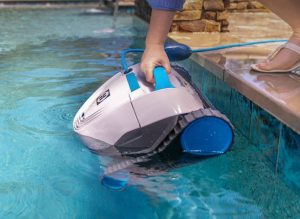
Robotic cleaners are standalone electric units with no connection to your pool’s plumbing. They plug into a standard 110V outdoor outlet and run on their own internal motor, pump, and filter. They cost more upfront but deliver the best cleaning quality and have zero impact on your pool pump or filter system.
How They Work
- Drive system: Tracks or wheels powered by electric motors move the robot across the floor and up walls.
- Suction system: An internal pump draws water through the bottom of the unit, trapping debris in a built-in filter basket or bag.
- Scrubbing brushes: Rotating brushes actively scrub algae, biofilm, and stuck-on debris from the pool surface.
- Navigation: Entry-level models use a random pattern. Mid-range models use gyroscopes. Premium models use sensors or mapping to cover the pool systematically.
- Power supply: A low-voltage transformer plugs into your outdoor outlet. A floating cable connects it to the robot in the pool.
Key Features by Price Tier
| Feature | Budget ($500–$700) | Mid-Range ($700–$1,000) | Premium ($1,000–$1,500+) |
|---|---|---|---|
| Floor cleaning | Yes | Yes | Yes |
| Wall climbing | Partial or none | Full walls | Full walls and waterline |
| Navigation | Random | Smart random / gyroscope | Mapping / AI navigation |
| App control | No | Some models | Yes |
| Filter type | Basic bag or basket | Fine and standard cartridges | Fine, ultra-fine, and leaf basket |
| Cycle time | 2–3 hours | 2–2.5 hours | 1.5–2.5 hours |
| Swivel cable | Some models | Yes | Yes, anti-tangle |
Top Brands
| Brand | Popular Models | Known For | Price Range |
|---|---|---|---|
| Dolphin (Maytronics) | Nautilus CC Plus, Sigma, M600 | Market leader, widest model range, excellent navigation | $600–$1,500 |
| Hayward | AquaVac 6 Series, TigerShark | Good for Hayward system owners, solid scrubbing | $500–$1,200 |
| Polaris (Zodiac) | Polaris VRX iQ+, Sport | Strong suction, good in debris-heavy pools | $600–$1,400 |
| Pentair | Prowler 930, 920 | Wall climbing, Bluetooth control | $700–$1,300 |
| Aiper | Seagull Pro, Scuba series | Cordless models, budget-friendly | $300–$800 |
Corded vs. Cordless
| Feature | Corded | Cordless |
|---|---|---|
| Runtime | Unlimited (plugged in) | 1.5–3 hours per charge |
| Suction power | Stronger, continuous | Weaker, battery-limited |
| Wall climbing | Most mid-range and up | Very few models |
| Long-term cost | Replace cable if damaged ($50–$100) | Battery replacement every 2–3 years ($100–$200) |
| Best for | Primary cleaner, thorough cleaning | Quick touch-ups, small or above-ground pools |
For a primary pool cleaner, go corded. Cordless units are best as a secondary cleaner for quick touch-ups between full cycles.
How to Use a Robotic Cleaner
- Place the power supply on the deck at least 10 feet from the pool (keep it dry).
- Uncoil the cable fully and lay it straight along the deck.
- Submerge the robot at an angle to let air escape, then set it on the floor.
- Plug in and power on. Select your cycle if the model offers options (floor only, floor and walls, etc.).
- Do not swim while the robot is running. The cable is a trip hazard and movement stirs up the debris the robot is trying to collect.
- When done, unplug first, then pull the unit out by its handle (never by the cable). Empty and rinse the filter before storing.
Robotic Cleaner Maintenance
| Task | Frequency |
|---|---|
| Empty and rinse the filter basket | After every use |
| Rinse the entire unit (tracks, brushes, body) | After every use |
| Inspect brushes for wear | Monthly |
| Check tracks and wheels for cracks or debris | Monthly |
| Inspect cable for cuts or kinks | Monthly |
| Deep clean filter cartridge (soak in filter cleaner) | Every 5–10 uses |
| Store in shade, upright on caddy if available | Always |
Which Type Is Right for You?
| Your Situation | Best Choice |
|---|---|
| Your pool came with one already | Use it. Suction cleaners work well and parts are cheap. |
| Tight budget, simple pool | Suction-side ($200–$350) |
| Heavy leaf and debris load | Pressure-side or robotic with large filter capacity |
| You want the best cleaning with least effort | Robotic ($600+) |
| You want to protect your pump and filter | Robotic or pressure-side (both keep debris out of your filter) |
| You already have a booster pump installed | Pressure-side (Polaris 280 or 380) |
| Large pool (30,000+ gallons) | Premium robotic or booster-driven pressure-side |
Frequently Asked Questions
My suction cleaner barely moves. What is wrong?
The most common causes are: pump speed too low, clogged pump basket reducing flow, air leak in the hose connections, or a worn diaphragm inside the unit. Start by checking the pump basket and looking for loose hose connections before buying new parts.
Can I run my suction cleaner on a variable speed pump?
Yes, but you need to run the pump at a high enough speed. Most suction cleaners require 2,000–2,500 RPM. Set a scheduled cleaning cycle at that speed and let it run for 2–4 hours per day. Do not try to run the cleaner on the low-speed energy-saving setting.
Do I need a leaf canister for my suction cleaner?
If you have trees near the pool, yes. A leaf canister ($30–$50) connects inline on the hose and catches leaves before they reach your pump basket. Without one, you will be emptying the pump basket constantly and risking pump damage from clogging.
How often should I run the automatic cleaner?
For most pools: run it daily during peak season, every 2–3 days in the off-season. After heavy rain or a storm, run an extra cycle. A cleaner pool is easier and cheaper to maintain chemically.
Can I swim while the cleaner is running?
With suction and pressure cleaners, yes, though you will stir up debris and the cleaner becomes less effective. With robotic cleaners, avoid it. The electrical cable is a trip hazard and the robot’s navigation is disrupted by swimmers in the pool.
My Polaris keeps getting stuck in the corner. How do I fix this?
The backup valve is not working correctly. It should trigger every 3–4 minutes to reverse the cleaner away from obstacles. If it does not click on that interval, the backup valve needs to be replaced. It is a simple part swap, costs about $15–$25.
Should I upgrade from a suction cleaner to a robotic?
It depends on what is bothering you. If the suction cleaner is handling your pool adequately, keep it. If you are spending too much time emptying the pump basket, your filter needs frequent cleaning, or you want wall and waterline coverage, a robotic cleaner is a worthwhile upgrade. The energy savings from not running the pump at high speed for cleaning can partially offset the cost over 2–3 years.
Related Pages
- Pool Pumps Guide — How your pump works and how it relates to suction and pressure cleaners
- Pool Filters Guide — How robotic and pressure-side cleaners reduce filter maintenance
- Weekly Pool Maintenance — Where automatic cleaning fits into your weekly routine
- Pool Equipment Costs and Lifespan — Full cost comparison of all cleaner types