Quick Answer
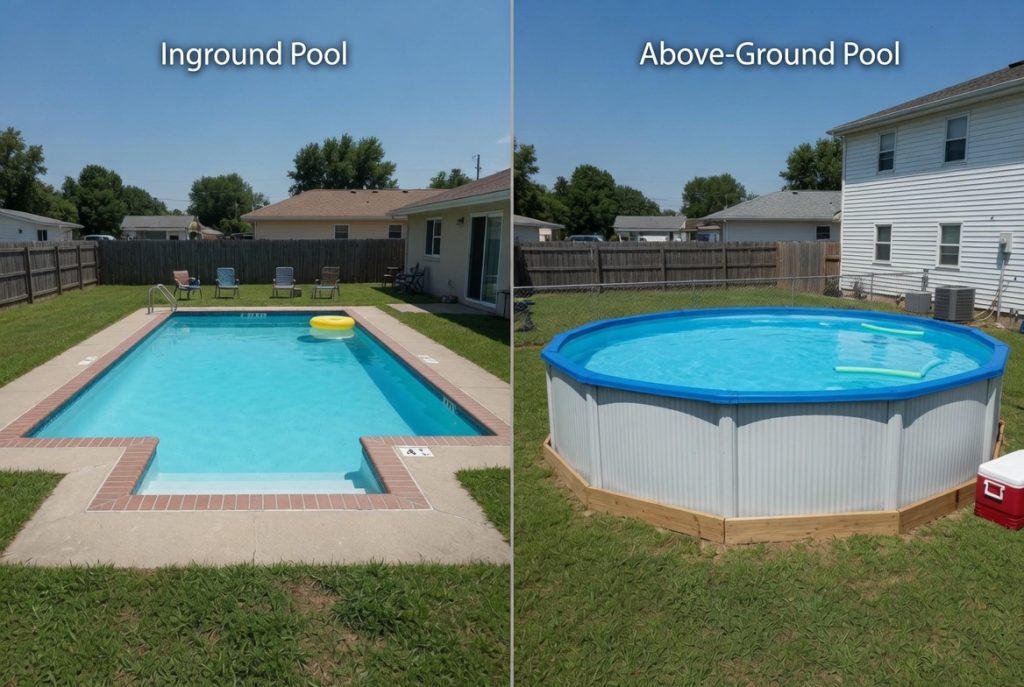
In-ground pools (concrete/gunite, fiberglass, or vinyl liner) are permanent, add home value, and last decades. Above-ground pools cost a fraction of the price, go up in a weekend, but don’t last as long and won’t increase your property value. If you’re buying a house with a pool, it’s almost certainly in-ground. If you’re adding one on a budget, above-ground gets you swimming this summer.
What You Need To Know
The Three In-Ground Pool Types
| Type | How It’s Built | Lifespan | Cost Range |
|---|---|---|---|
| Concrete / Gunite | Rebar frame sprayed with concrete, then finished with plaster, pebble, or tile | 50+ years (resurface every 10-15) | $50,000–$100,000+ |
| Fiberglass | Pre-molded shell delivered on a truck and lowered into the hole | 25-30+ years | $40,000–$85,000 |
| Vinyl Liner | Metal or polymer wall panels with a custom vinyl sheet lining the interior | Structure 20+ years; liner replacement every 7-12 years | $35,000–$65,000 |
Above-Ground Pools
Above-ground pools sit on top of the ground (or partially recessed) with a metal, resin, or steel frame supporting a vinyl liner. They range from basic inflatable setups to semi-permanent structures with decking.
| Type | Lifespan | Cost Range |
|---|---|---|
| Inflatable / Frame | 1-5 years | $200–$1,500 |
| Steel/Resin Wall | 10-20 years | $3,000–$8,000 |
| Semi-In-Ground | 15-25 years | $8,000–$25,000 |
Quick Comparison: In-Ground vs. Above-Ground
| Factor | In-Ground | Above-Ground |
|---|---|---|
| Cost | $35K–$100K+ | $200–$25K |
| Installation time | 6-16 weeks | 1-3 days |
| Home value | Adds 5-8% in warm climates | No increase (sometimes negative) |
| Customization | Any shape, depth, or feature | Round or oval; limited sizes |
| Depth | 3-8+ feet (variable) | 4 feet (usually uniform) |
| Maintenance | Same chemical care; more equipment | Same chemical care; simpler equipment |
| Permits required | Always | Sometimes (check local codes) |
Pro Tip: If you’re house-hunting in the Sun Belt, a well-maintained in-ground pool is an asset. In northern states, it may actually hurt resale value because buyers see it as a maintenance burden they’ll use 3 months a year.
Deep Dive
Concrete / Gunite – The Premium Choice
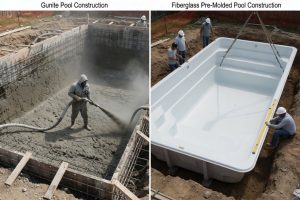
Concrete pools (technically “gunite” or “shotcrete” depending on the application method) are the most common in-ground pool in the southern U.S. A steel rebar cage is built in the excavated hole, then concrete is sprayed over it at high pressure. After curing, the interior gets a finish coat – plaster (cheapest, 5-10 year life), pebble aggregate (mid-range, 10-15 years), or glass tile (premium, 15-20+ years).
Pros:
- Completely custom – any shape, depth, bench, tanning ledge, spillover spa
- Most durable structure (the shell itself can last 50+ years)
- Compatible with any equipment: salt systems, heaters, robotic cleaners, automation
- Adds the most resale value
Cons:
- Most expensive upfront
- Longest build time (2-4 months typical; weather delays common)
- Rough surface can be hard on bare feet (plaster and pebble)
- Requires resurfacing every 10-15 years ($5,000-$15,000)
- More porous surface = slightly higher chemical consumption vs. fiberglass
💲 Cost: A concrete pool including basic equipment, decking, and a standard finish runs $50,000–$75,000 in most markets. Add a spa, upgraded finishes, automation, and custom water features and you’re easily at $80,000–$120,000+.
Fiberglass – Fast and Low-Maintenance
Fiberglass pools are factory-built shells that ship to your house on a flatbed truck. The builder excavates the hole, sets the shell, backfills around it, and connects the plumbing. You can be swimming in 2-3 weeks.
Pros:
- Fastest installation (1-3 weeks from dig to swim)
- Smooth gelcoat surface — gentle on skin, resists algae growth
- Lowest long-term maintenance cost (no resurfacing needed)
- Non-porous surface means less chemical use
Cons:
- Limited to pre-made shapes and sizes (no full customization)
- Max width ~16 feet (limited by road transport)
- Gelcoat can fade or develop osmotic blisters over 15-20 years
- Not ideal for very large or very deep pools
- If the ground shifts significantly, the shell can crack (rare but not repairable like gunite)
Vinyl Liner – Budget In-Ground
Vinyl liner pools use a frame of steel, aluminum, or polymer panels bolted together in the excavated hole, with a custom-cut vinyl sheet draped over the top. The liner holds the water; the walls just hold the liner in shape.
Pros:
- Cheapest in-ground option
- Smooth, non-abrasive surface
- Liner patterns give a wide range of color/design options
- Installation in 2-4 weeks
Cons:
- Liner replacement every 7-12 years ($3,000-$6,000 each time)
- Vinyl tears from sharp objects, pets, or rough play (patchable but annoying)
- Fewer shape options than gunite
- Can’t add many built-in features (no raised bond beam, limited bench options)
- Most common in northern U.S. — less common in the South where gunite dominates
Above-Ground
The above-ground pool market ranges from $300 Intex setups from Amazon to $20,000+ semi-in-ground pools with composite decking. For families who want to swim without the five-figure commitment, a quality steel-wall above-ground (Doughboy, Wilbar, or Cornelius brands) with a good pump and filter setup will last 15+ years.
The water chemistry is identical to in-ground pools — same chlorine, same pH balancing, same testing routine. The main difference is the equipment is smaller and less expensive, and you’ll need a winter closing plan if you’re in a freeze zone.
Pro Tip: If you’re considering above-ground, spend the extra money on a resin or steel-wall model over an inflatable frame pool. The inflatables look great on day one and look terrible by month six. A $4,000 steel-wall pool will outlast five $800 Intex pools.
Which Type Is Right for You?
| Your Situation | Best Fit |
|---|---|
| Building a forever home in a warm climate | Concrete/Gunite |
| Want in-ground with minimal hassle | Fiberglass |
| In-ground on a tighter budget | Vinyl liner |
| Renting or may move in 3-5 years | Above-ground (steel wall) |
| Kids want to swim this summer for under $1K | Above-ground (frame/inflatable) |
FAQ
Do all pool types need the same maintenance?
Yes — chlorine levels, pH balance, and filtration apply to every pool regardless of type. The equipment might be different sizes, but the chemistry and weekly routine are the same. Our entire Water Chemistry section applies to all pool types.
Does a pool increase home value?
In warm-climate states (Texas, Florida, Arizona, California…), a well-maintained in-ground pool typically adds 5-8% to home value. In colder climates, the effect is neutral or slightly negative. Above-ground pools don’t add value.
How long does it take to build an in-ground pool?
Fiberglass: 2-3 weeks. Vinyl liner: 2-4 weeks. Concrete/gunite: 2-4 months. Weather, permits, and builder schedules can push these timelines significantly.