
Quick Answer
Pool filters remove debris and particles from your water. There are three types: cartridge (easiest maintenance – hose off the cartridges every 4-8 weeks), sand (backwash every few weeks, replace sand every 5-7 years), and DE/diatomaceous earth (finest filtration down to 3-5 microns but most labor-intensive). For most residential pools, a cartridge filter is the best balance of filtration quality, low maintenance, and no water waste. Sand filters are the cheapest but filter the coarsest. DE filters give the clearest water but require the most upkeep.
What You Need To Know
The Three Filter Types Compared
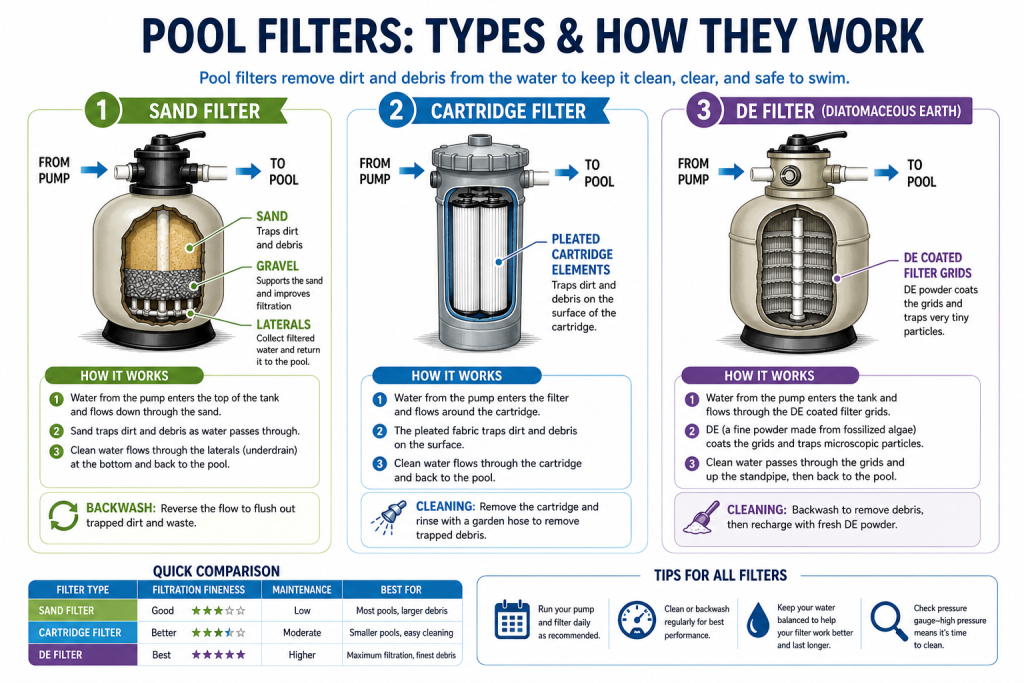
| Feature | Cartridge | Sand | DE (Diatomaceous Earth) |
|---|---|---|---|
| Filtration Level | 10-15 microns | 20-40 microns | 3-5 microns |
| Water Clarity | Very good | Good | Excellent (sparkling) |
| Cleaning Method | Remove and hose off cartridges | Backwash (reverse water flow) | Backwash + add DE powder |
| Water Waste | None | 200-500 gallons per backwash | 200-500 gallons per backwash |
| Maintenance Effort | Low-moderate | Low | Moderate-high |
| Media Replacement | Cartridges every 1-3 years ($100-200) | Sand every 5-7 years ($50-100) | DE grids every 5-10 years ($150-300) |
| Equipment Cost | $200-500 | $200-400 | $400-800 |
| Best For | Most residential pools | Budget-conscious, above-ground | Pools where crystal clarity is priority |
How to Know When to Clean Your Filter
Every pool filter has a pressure gauge on top. This is your cleaning indicator.
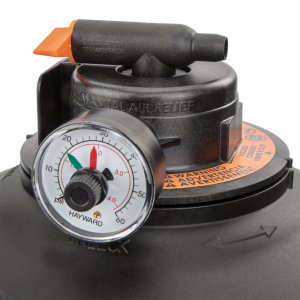
- Record your “clean baseline” PSI after installing new media or a thorough cleaning. Write it on a sticker on the tank (e.g., “Clean PSI: 12”)
- When pressure rises 8-10 PSI above baseline, it’s time to clean
- If baseline is 12 PSI and the gauge reads 20-22 PSI – clean the filter
- Never let pressure exceed 25-30 PSI above baseline – this puts stress on the tank, plumbing, and pump
Pro Tip: If the pressure gauge reads zero while the pump is running, it’s broken – replace it. They’re $8-12 at any pool store. A working pressure gauge is your only real-time indicator of filter health. Don’t run without one.
Deep Dive
Cartridge Filters – How They Work and How to Maintain Them
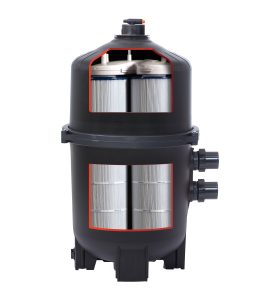
Hayward SwimClear Filter with a cutout showing 4 filter cartridges.
A cartridge filter contains one to four pleated polyester cartridges inside a pressurized tank. Water flows from outside the cartridges inward, trapping particles in the pleats. Clean water passes through to the return lines.
Routine cleaning (every 4-8 weeks):
- Turn off the pump
- Open the air relief valve on top of the filter tank to release pressure
- Remove the tank lid or top – this varies by model (some have a locking band/belly band, others have a clamp ring)
- Lift out the cartridge(s) – they slide straight up
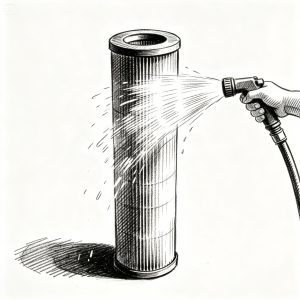
- Hose each cartridge with a garden hose and nozzle:
- Spray at a 45° angle into each pleat, working from top to bottom
- Rotate the cartridge and repeat
- Continue until water runs clear from all pleats
- Inspect for damage – tears, collapsed pleats, deteriorating end caps = replace
- Reinstall cartridges, replace lid, close band/clamp
- Inspect the tank O-ring – clean and lubricate with silicone O-ring lube. Replace if cracked or flattened.
- Open the air relief valve, turn on pump – close the valve once a steady stream of water appears
- Record the new clean baseline PSI
Deep cleaning (1-2x per year):
- Soak cartridges overnight in a solution of water + cartridge cleaner (or TSP – trisodium phosphate)
- This dissolves oils, sunscreen, body lotions, and mineral scale that hosing can’t remove
- Rinse thoroughly before reinstalling
- Best times: spring opening and mid-summer
💲 Cost: Replacement cartridges run $30-80 each depending on size and brand. A 4-cartridge filter needs a full set every 1-3 years ($120-250). You can extend cartridge life significantly with regular hosing and annual chemical soaks.
Sand Filters – How They Work and How to Maintain Them
A sand filter is a large tank filled with specially graded pool filter sand (#20 silica sand). Water enters from the top, percolates down through 200-300 lbs of sand, and exits through a collection manifold at the bottom. Debris is trapped in the top few inches of sand.
The multiport valve:
Sand filters have a multiport valve on top (or side) with these positions:
| Position | What It Does |
|---|---|
| Filter | Normal operation – water flows through sand, clean water returns to pool |
| Backwash | Reverses water flow – flushes debris out of sand to waste |
| Rinse | Short flush after backwashing to settle the sand bed before returning to Filter |
| Waste | Bypasses the filter – pumps water directly out (for draining or vacuuming heavy debris) |
| Recirculate | Water returns to pool without passing through sand (for mixing chemicals) |
| Closed | Blocks all flow – for winterizing or pump maintenance |
⚠️ IMPORTANT: Always turn off the pump BEFORE changing the multiport valve position. Turning the valve while the pump is running can crack the valve housing or damage internal gaskets.
How to backwash:
- Turn off the pump
- Attach a backwash hose to the waste port (if not already attached)
- Turn the multiport to Backwash
- Turn on the pump – dirty water flows out the waste line
- Watch the sight glass (if your valve has one) — when the water runs clear (usually 2-3 minutes), proceed
- Turn off the pump
- Turn the multiport to Rinse
- Turn on the pump – run for 30 seconds
- Turn off the pump
- Turn the multiport back to Filter
- Turn on the pump – you’re back to normal operation
- Note the new clean baseline PSI
Sand replacement:
- Every 5-7 years, the sand grains become rounded and lose their debris-trapping ability
- Signs it’s time: water clarity doesn’t improve after backwashing, or you see sand in the pool (broken lateral)
- Use #20 silica pool filter sand (50 lb bags, $10-12 each). Most residential sand filters take 200-350 lbs
- Alternative media: ZeoSand (zeolite) filters finer than #20 sand and lasts longer. FilterGlass is another option. Both are drop-in replacements
DE Filters – How They Work and How to Maintain Them
DE (diatomaceous earth) filters provide the finest filtration – 3-5 microns, which is finer than most bacteria. Inside the tank are fabric-covered grids. You coat these grids with DE powder (the fossilized remains of diatoms, a type of algae). Water passes through the DE coating, which traps incredibly fine particles.
How to backwash and recharge:
- Backwash similar to a sand filter (multiport valve or push-pull valve)
- After backwashing, you must add fresh DE powder through the skimmer to recoat the grids
- Dosage: typically 1 lb of DE per 10 sqft of filter area (check your model’s specs)
- Pre-mix DE in a bucket of water, then pour the slurry into the skimmer with the pump running
- The DE coats the grids within a few minutes
Annual teardown:
- Once a year, open the filter tank and remove the grid assembly
- Hose off each grid to remove the old DE cake
- Soak grids in a filter cleaner or dilute muriatic acid solution to remove scale and oils
- Inspect grid fabric for tears – replace any damaged grids
- Reassemble, refill, and add fresh DE
DE safety note: DE powder is a fine silica dust. Wear a dust mask when handling it – you don’t want to inhale silica particles. Once it’s wet (in the filter or dissolved in a bucket), it’s harmless.
Which Filter Is Right for Your Pool?
Choose cartridge if:
- You want low maintenance with no water waste
- You have a variable speed pump (cartridge filters work great with low-flow VS pumps)
- You want good-to-excellent water clarity
- You don’t want to deal with backwash hoses or waste lines
- You live in an area with water restrictions
Choose sand if:
- Budget is the primary concern
- You have an above-ground pool (most come with sand filters)
- You prefer the simplest possible operation (just backwash and go)
- You’re OK with slightly less clear water than cartridge or DE
Choose DE if:
- Crystal-clear, sparkling water is your top priority
- You’re willing to do the extra maintenance (adding DE after every backwash, annual teardown)
- You have a larger pool where superior filtration is worth the effort
Filter Sizing
Filters are rated by square footage of filtration area (for cartridge and DE) or by sand capacity and flow rate (for sand). The general rule:
- Bigger is always better for filters – a larger filter traps more debris before needing cleaning, and provides lower resistance (better for energy efficiency)
- Minimum recommendation: 100 sqft per 10,000 gallons for cartridge filters; scale proportionally for larger pools
- Never undersize a filter – it’ll clog quickly, restrict flow, and make your pump work harder
| Pool Size | Cartridge (sqft) | Sand (tank diameter) | DE (sqft) |
|---|---|---|---|
| Up to 15,000 gal | 200-300 sqft | 19-22″ | 36-48 sqft |
| 15,000–30,000 gal | 300-500 sqft | 22-26″ | 48-72 sqft |
| 30,000+ gal | 500+ sqft | 26-30″ | 72+ sqft |
Pro Tip: With variable speed pumps becoming standard, cartridge filters have a natural advantage. VS pumps run at lower flow rates for longer periods, which is exactly how cartridge filters perform best – slow flow through lots of surface area. Sand and DE filters were designed for the high-flow, short-run cycles of single-speed pumps. If you’re upgrading your pump to VS, it’s a good time to consider switching to cartridge if you don’t already have one.
FAQ
How often should I clean my filter?
Every 4-8 weeks for cartridge filters (when pressure rises 8-10 PSI). Backwash sand or DE filters when pressure rises 8-10 PSI above clean baseline — could be every 2-6 weeks depending on debris load. In fall (leaf season) you may need to clean weekly. In winter, monthly or less.
My filter pressure is high even right after cleaning. What’s wrong?
If cleaning no longer restores the baseline pressure, the filter media is reaching end of life. For cartridge: cartridges are clogged with oils/minerals that hosing and soaking can’t remove — replace them. For sand: the sand bed has compacted or “channeled” — replace the sand. For DE: grids may be torn or calcified — inspect and replace as needed.
Can I use a pressure washer to clean cartridges?
No — pressure washers damage the pleated fabric, opening holes and shortening cartridge life. Use a regular garden hose with a nozzle. The water pressure from a standard hose is all you need. If debris is stubborn, chemical soaking is the answer, not more water pressure.
Why is sand coming out of my returns into the pool?
A broken lateral (the slotted tubes at the bottom of the sand tank that collect filtered water). When a lateral cracks, sand escapes into the return line. Turn off the pump and replace the damaged lateral. You may need to remove some sand to access it. Laterals are inexpensive ($5-15 each) but require some disassembly.
Is glass media better than sand?
Glass filter media (like FilterGlass or ZeoSand made from zeolite) filters finer particles than #20 sand, lasts longer, is lighter, and doesn’t channel as easily. It costs about 2-3x more than sand but lasts 2-3x longer. If you’re doing a sand change, it’s a worthwhile upgrade for minimal extra cost.
Can I switch from one filter type to another?
Yes, but it requires replacing the entire filter unit – the tank, media, and sometimes the plumbing connections. If you’re upgrading your pump and filter at the same time, switching types is easy since the plumber is already doing the work. The most common upgrade path is sand – cartridge for reduced maintenance and better VS pump compatibility.